
Key issues
- In the week ending 4 March 2026, low-pressure systems and tropical lows brought heavy rainfall to much of northern and central Australia
- Severe weather and flood warnings remain in place throughout parts of the Northern Territory and Queensland, as well as South Australia and New South Wales. Flash flooding particularly in South Australia is set to result in major disruptions to supply chains, with freight operators warning of major delays across regional Australia after severe weather washed out key rail links, cutting off one of the nation’s most important east–west supply routes for weeks.
- Over the 8-days to 12 March 2026, rainfall is forecast for much of the north and southeast of Australia.
- Low rainfall totals (1-10 millimetres) are forecast for cropping regions in Western Australia and South Australia, while Victoria is forecast to receive 5-15 millimetres.
- Higher falls are forecast for much of New South Wales (10-50 millimetres) and Queensland (15- 150 millimetres), with falls higher in northern regions.
- Rainfall was highly variable across Australia during February 2026, with well above average rainfall across much of central and northern Australia. In contrast, parts of the east and west saw below average rainfall.
- Pasture growth for the three months to February 2026 has been mixed across Australia. Above average rainfall totals resulted in average to extremely high pasture growth across large parts of northern Australia. Below average to extremely low pasture growth was recorded across parts of eastern and western Australia.
- Soil moisture models indicate low soil moisture levels parts of eastern and southern Australia, with above average soil moisture modelled in the northern tropics and central Australia.
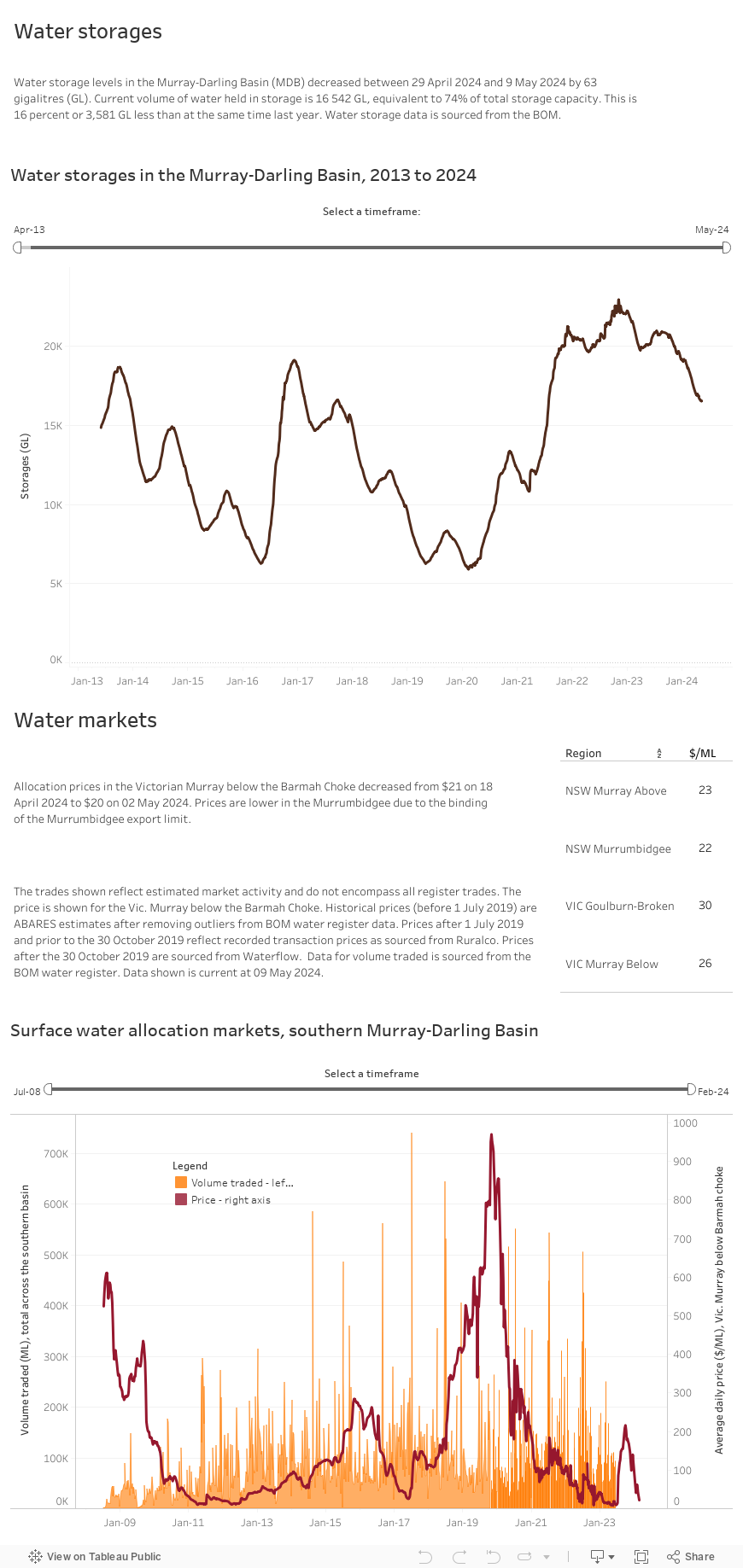
- Water storage levels in the Murray-Darling Basin (MDB) decreased by 44 gigalitres (GL) between 26 February 2026 and 5 March 2026. The current volume of water held in storages is 10,650 GL, equivalent to 48% of total storage capacity. This is 19% or 2,428 GL lower than the same time last year. Water storage data is sourced from the Bureau of Meteorology.
- Allocation prices in the Victorian Murray below the Barmah Choke decreased from $454/ML on 26 February 2026 to $445/ML on 5 March 2026. Trade from the Goulburn to the Murray is closed. Trade downstream through the Barmah Choke is closed. Trade from the Murrumbidgee to the Murray is open.
Full report
Weekly Australian Climate, Water and Agricultural update
Read the full report for the week ending 5 March 2026
If you have difficulty accessing these files, contact us for help.
Water
Water storages, water markets and water allocations - current week
The Tableau dashboard may not meet accessibility requirements. For information about the contents of these dashboards contact ABARES.
Commodities
Information on weekly price changes in agricultural commodities is now available at the Weekly commodity price update.