
Insights and Working Paper - Sequestration on Agricultural Land: Impacts and Policy Trade-offs
The recently announced Net Zero Plan called out a significant role for land-based sequestration as part of the net zero transition, totalling 119 million tonnes of carbon to be sequestered in the landscape by 2050. This Insights paper shows that farmers can benefit while meeting this challenge.
If you have difficulty accessing these files, contact us for help.
Overview
This Insights paper models the 119 million tonnes sequestration projection for reforestation and managed regeneration from the Treasury Net Zero Transformation Modelling and Analysis to understand how it may influence land use across Australia, and the broader implications for the agricultural sector and regional economies. The trade-offs associated with policy responses to restrict land use change are also explored in the event that these are considered in the future.
The analysis presented in this paper, and the various scenarios explored, do not represent government policy. They are provided to shed light on discussions around land-based sequestration. Future work may extend this analysis to examine issues around land use change for renewables and transmission infrastructure and the plantation forestry method.
Key findings
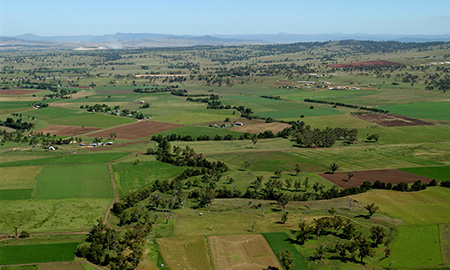
- Under the 119 million tonnes of land-based sequestration scenario, it is estimated that about 18 million hectares of sequestration projects would be established cumulatively by 2050. This is equivalent to about 4% of agricultural land in Australia.
- Much of this will be partial conversion where farmers operate a mixed enterprise with both agriculture and sequestration.
- The percentage impact on a growing agricultural sector is likely to be small – estimated at 2.1% of projected agricultural revenue in 2050.
- Sequestration projects will also generate billions of dollars in benefits to landholders and help deliver a lower cost transition pathway.