
Key issues
- In the week ending 28 January 2026, rainfall was recorded across northern regions of Australia, while central and most southern areas remained comparably dry.
- Tropical Cyclone Luana and a tropical low, brought widespread falls of between 50 and 300 millimetres to the north of Western Australia and Queensland.
- Continued rainfall across the Gulf region of north Queensland is likely to have exacerbated flooding impacts and delayed recovery efforts.
- Elsewhere, these falls are expected to support soil moisture storage and benefit crop and pasture production across the broader region.
- Tropical Cyclone Luana and a tropical low, brought widespread falls of between 50 and 300 millimetres to the north of Western Australia and Queensland.
- Over the 8-days to 5 February 2026, rainfall is forecast for the north and east of the country.
- Continued heavy falls are forecast across major flood warning areas of northern Queensland. If realised these falls are likely to further exacerbate flooding and continue to slow recovery efforts. Outside of flood affected regions these substantial falls across northern Australia are likely to support soil moisture levels, replenish water supplies and sustain high pasture availability and growth.
- The expected falls in Queensland are likely to further support summer cropping regions.
- The national rainfall outlook for February to April 2026 indicates an increased probability of below median rainfall across areas of northern, central and parts of south-eastern Australia, while parts of southern Queensland and north-eastern New South Wales are more likely to see above median rainfall.
- If realised, close to average forecast rainfall for areas of eastern Australia is expected to support summer crop and pasture production.
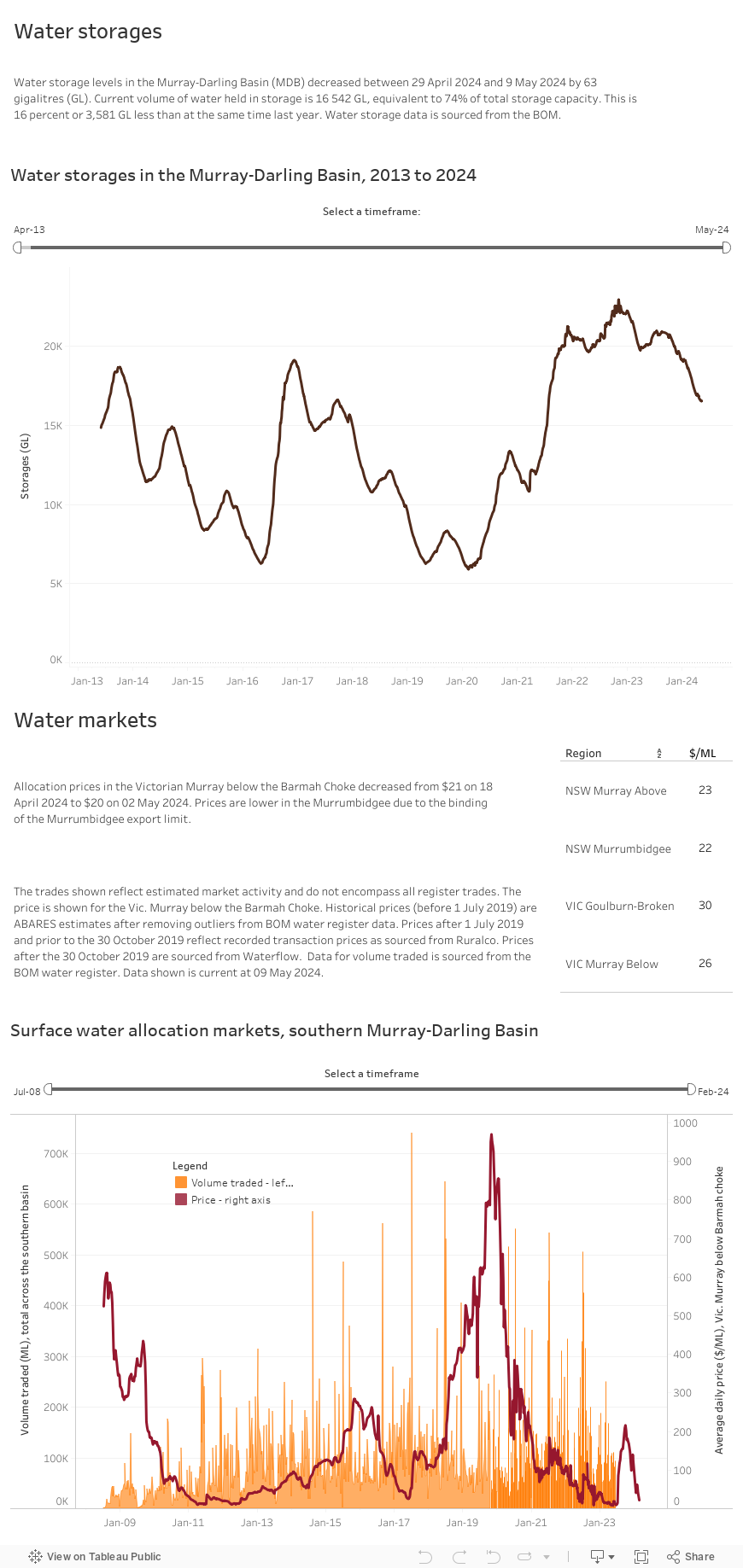
- Water storage levels in the Murray-Darling Basin (MDB) remained unchanged between 22 January 2026 and 29 January 2026. The current volume of water held in storages is 12,695 GL, equivalent to 57% of total storage capacity. This is 9% or 2,005 GL less than the same time last year. Water storage data is sourced from the Bureau of Meteorology.
- Allocation prices in the Victorian Murray below the Barmah Choke decreased from $413/ML on 22 January 2026 to $440/ML on 29 January 2026. Trade from the Goulburn to the Murray is closed. Trade downstream through the Barmah Choke is closed. Trade from the Murrumbidgee to the Murray is open.
Full report
Weekly Australian Climate, Water and Agricultural update
Read the full report for the week ending 29 January 2026
If you have difficulty accessing these files, contact us for help.
Water
Water storages, water markets and water allocations - current week
The Tableau dashboard may not meet accessibility requirements. For information about the contents of these dashboards contact ABARES.
Commodities
Information on weekly price changes in agricultural commodities is now available at the Weekly commodity price update.