
Key issues
- In the week ending 22 April 2026, rainfall was recorded across the north-east of the country, as well as scattered areas of the southeast and southwest.
- Most cropping regions of Queensland, New South Wales, Victoria, and South Australia saw little to no rainfall, with exceptions in northern Queensland where between 10-50 millimetres was observed.
- Mainly dry conditions across Queensland and New South Wales are expected to support the harvest of late summer crops.
- Across south-eastern and south-western regions, the mainly dry conditions would have provided unimpeded field access for the sowing of early canola and dual purpose crops (for forage and grain) such as oats, barley and vetch.
- Over the 8 days to 30 April 2026 low pressure systems are expected to bring rainfall to isolated parts of Australia, with conditions being broadly dry:
- Low rainfall (0-10 millimetres) is forecast for Queensland, with 0-5 millimetres expected in New South Wales, Victoria, and South Australia. Falls of up to 25 millimetres are forecast for western regions of Western Australia.
- If realised, falls across Western Australia are expected to support the germination and growth of early sown winter crops and provide a timely boost to soil moisture levels and encourage further plantings.
- The national rainfall outlook for May to July 2026 indicates an increased probability of below median rainfall across much of eastern and south-eastern Australia.
- These expected below average falls represent an increased downside production risk for the upcoming 2026–27 winter cropping season and autumn pasture growth.
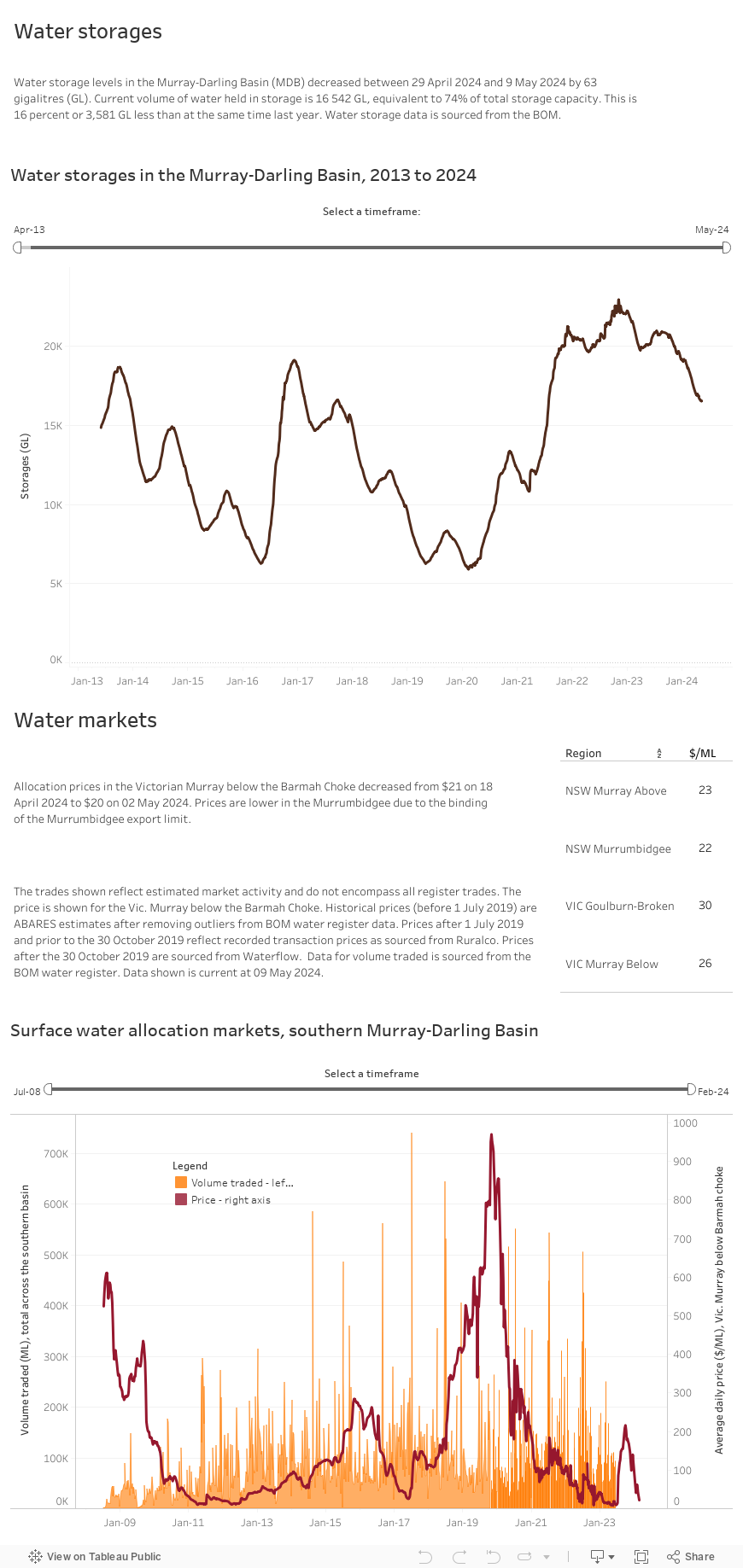
- Water storage levels in the Murray-Darling Basin (MDB) decreased by 105 gigalitres (GL) between 16 April 2026 and 23 April 2026. The current volume of water held in storages is 10,156 GL, equivalent to 46% of total storage capacity. This is 14% or 1,629 GL less than the same time last year. Water storage data is sourced from the Bureau of Meteorology.
- Allocation prices in the Victorian Murray below the Barmah Choke increased from $381/ML on 16 April 2026 to $400/ML on 23 April 2026. Trade from the Goulburn to the Murray is closed. Trade downstream through the Barmah Choke is open. Trade from the Murrumbidgee to the Murray is open.
Full report
Weekly Australian Climate, Water and Agricultural update
Read the full report for the week ending 23 April 2026
If you have difficulty accessing these files, contact us for help.
Water
Water storages, water markets and water allocations - current week
The Tableau dashboard may not meet accessibility requirements. For information about the contents of these dashboards contact ABARES.
Commodities
Information on weekly price changes in agricultural commodities is now available at the Weekly commodity price update.