

Key issues
- In In the week ending 18 November 2026, low-pressure systems brought storms to much of the east, while northern and south-western areas also saw localised heavy falls. Most Queensland cropping regions saw between 25-100 millimetres of rainfall over the period, with south-western Queensland and much of northern New South Wales seeing lower falls of 5-15 millimetres.
- These lower falls in the south-western Queensland and northern New South Wales are expected to facilitate field access for summer crop planting and winter crop harvest activities. However, the heavier falls across much of the remainder of Queensland have likely further disrupted planting and harvesting activities.
- Over the eight days from 19 to 26 November 2026, rainfall is forecast across much of northern and eastern Australia.
- Across eastern cropping regions, falls are expected to be considerable, with falls of 10- 100 millimetres in New South Wales and Victoria, while Queensland is forecast to receive between 10-50 millimetres.
- If realised, these falls are likely to continues to support pasture growth across eastern and northern Australia, and the development of summer crops already in the ground in Queensland and northern New South Wales. However, these falls are likely to further delay winter crop harvest activities and increase the risk of grain quality downgrades.
- Rainfall in October 2026 was broadly positive across the world’s major grain and oilseed producing regions, with some variability in crop production outcomes. Global production conditions were broadly positive for wheat, maize, soybeans, and rice. However, unfavourable conditions across parts of the United States, India, Europe and Southeast Asia are a risk to potential global production outcomes for major grains and oilseeds.
- Global production conditions have been slightly less favourable to those used to formulate ABARES 2026–27 forecasts of global grain supplies and world prices in the September 2026 Agricultural Commodities Report. As a result, global grain and oilseed production are likely to decrease below the estimates in the September forecast, due to declines in global maize and rice production more than offsetting a small, expected increase in global wheat and soybeans production.
- According to the Australian Agricultural Drought Indicators November 2026 estimates, taking into account climate and price impacts, broadacre farm profits for 2026–27 at a national level are forecast to be above average (82nd percentile) compared to the past 33 years.
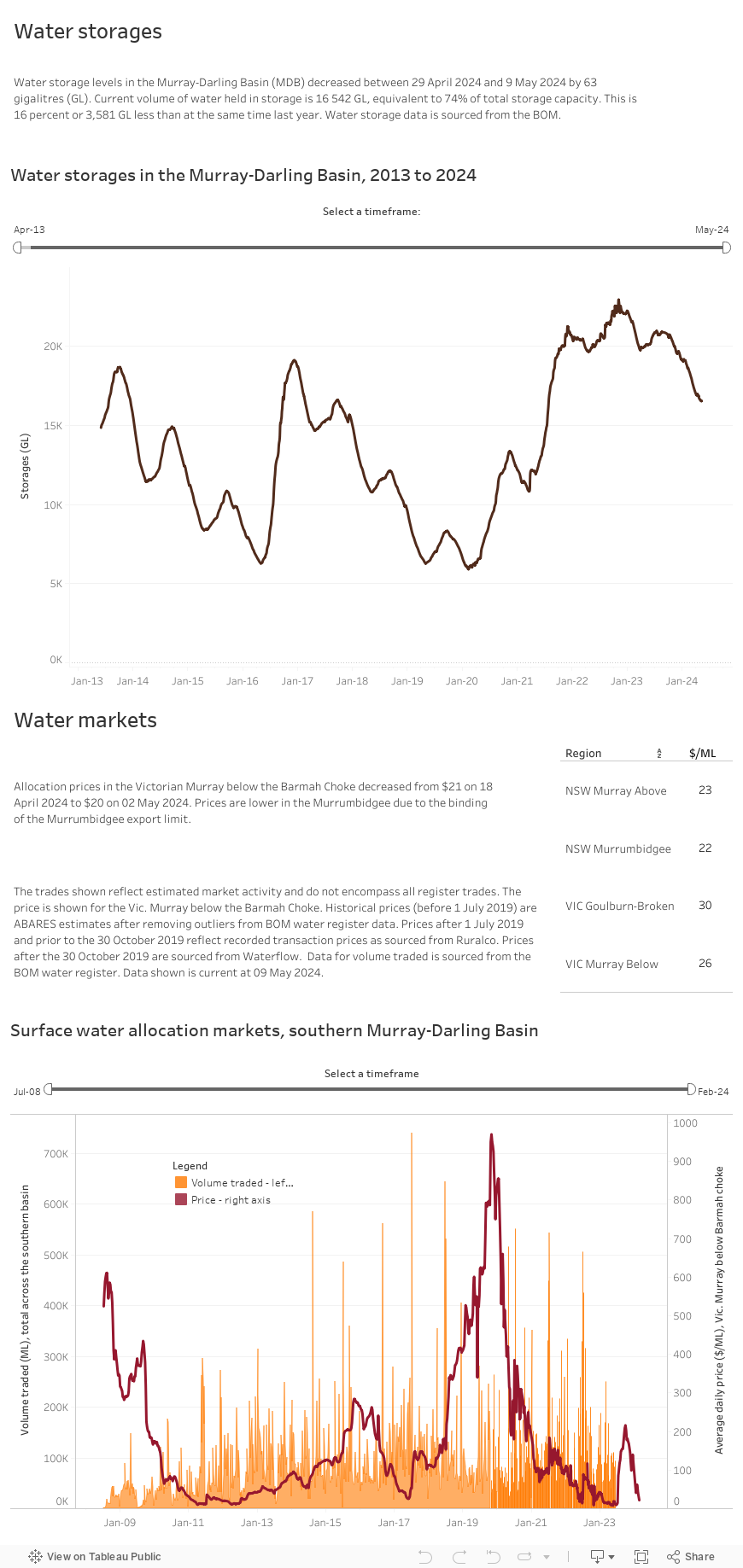
- Allocation prices in the Victorian Murray below the Barmah Choke decreased from $279/ML on 12 November 2026 to $255/ML on 19 November 2026. Trade from the Goulburn to the Murray is closed. Trade downstream through the Barmah Choke is closed. Trade from the Murrumbidgee to the Murray is closed.
- No water storage level update for the Murray-Darling Basin (MDB) is available this week.
Full report
Weekly Australian Climate, Water and Agricultural update
Read the full report for the week ending 19 November 2026
If you have difficulty accessing these files, contact us for help.
Water
Water storages, water markets and water allocations - current week
The Tableau dashboard may not meet accessibility requirements. For information about the contents of these dashboards contact ABARES.
Commodities
Information on weekly price changes in agricultural commodities is now available at the Weekly commodity price update.