

Download full report and data
The Australian Crop Report contains ABARES forecasts for the area, yield and production of Australia’s major winter and summer broadacre crops. Forecasts are made at the Australian state level.
Download the full report
- Australian Crop Report: June 2026 No. 218 (PDF - 894 KB)
- Australian Crop Report: June 2026 No. 218 (Word - 4.67 MB)
Download the data
Email us at info.abares@aff.gov.au if you are having difficulties accessing or downloading these files.
Key points
- National planting of winter crops has been impacted by soil moisture availability and high input costs. Despite this, area planted for the 2026–27 crop is expected to remain relatively high at 23.6 million hectares.
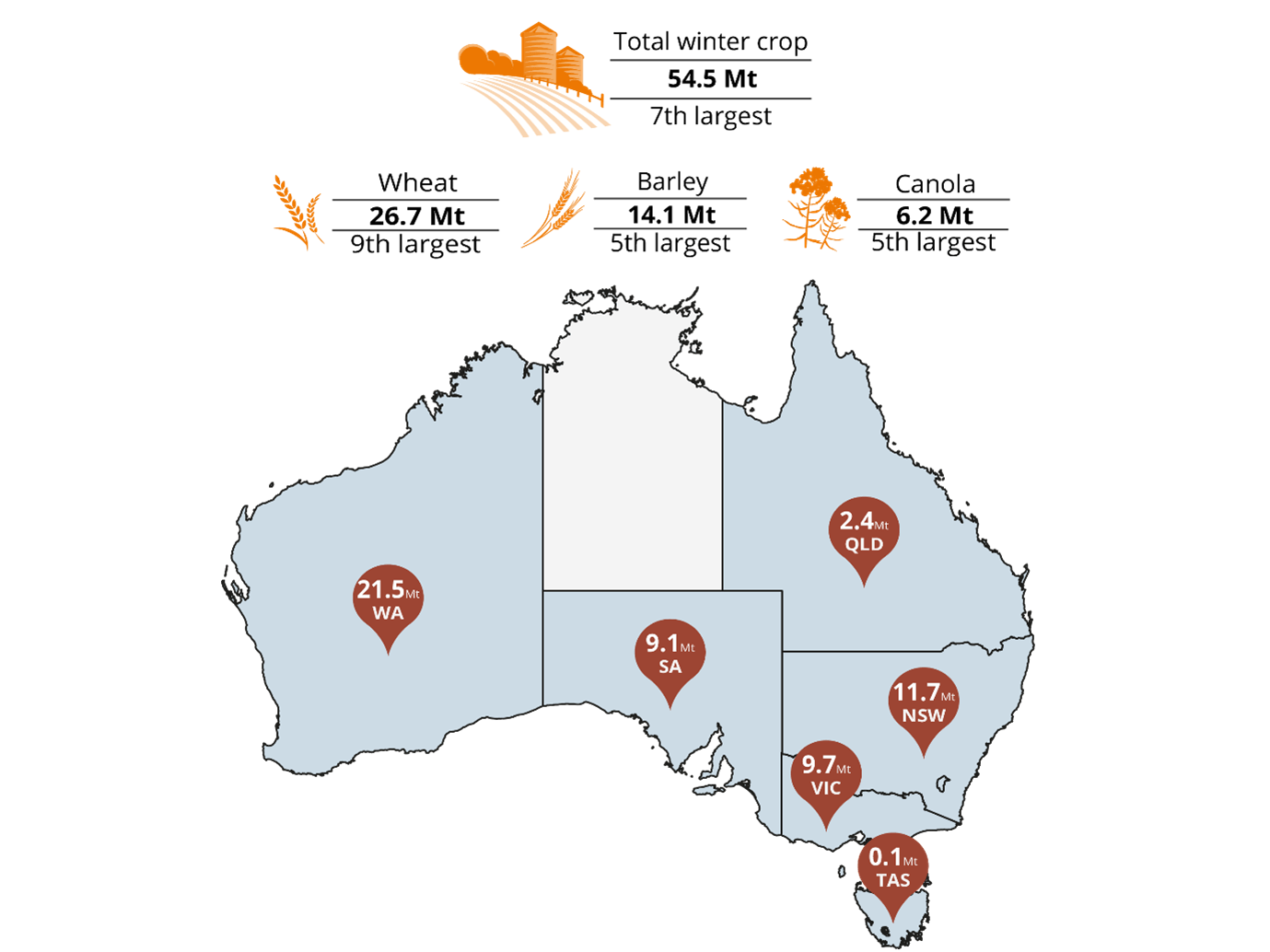
- National winter crop production is forecast to decrease 21% to 54.5 million tonnes in 2026–27, reflecting an expected fall in the total area planted and lower yields.
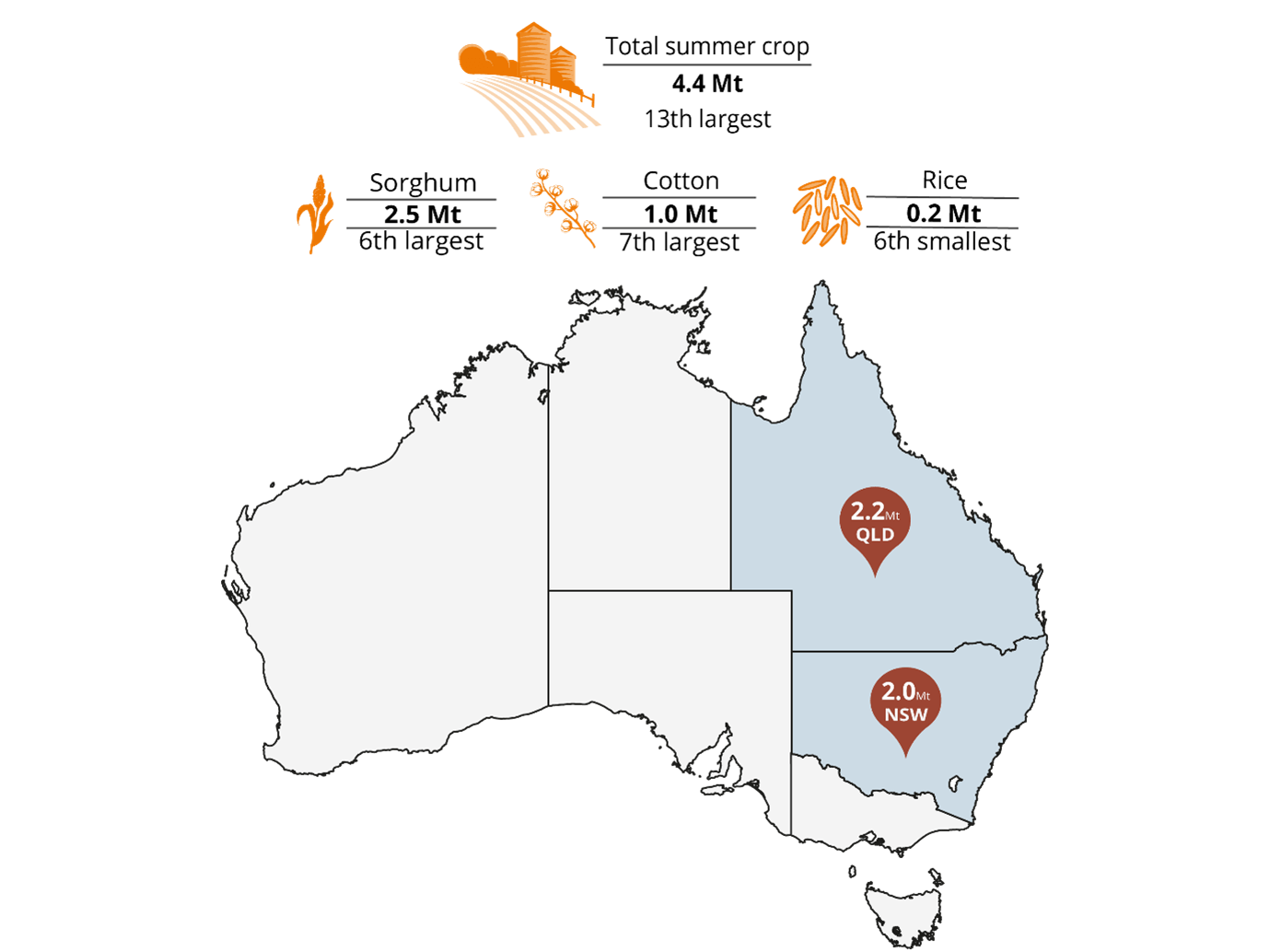
- Summer crop production is estimated to have fallen by 15% to 4.4 million tonnes in 2025–26, still well above the 10-year average to 2024–25.
High input costs and a mixed start impacting planting decisions
Australian winter crop production is forecast to decrease by 21% to 54.5 million tonnes in 2026–27 (Figure 1). This is 12% below the 5-year average but 4% above the 10-year average to 2025–26, reflecting lower expected average yields and a fall in area planted. Despite a significant increase in both fuel and fertiliser prices, a favourable start to the season has incentivised a close to average winter crop area to be planted in Western Australia, South Australia, Victoria and parts of southern New South Wales, with some notable changes in crop mix. Conversely, persistent dry conditions are expected to result in a significant fall in the area planted to winter crops in 2026–27 through northern New South Wales and southern Queensland. While there is ongoing uncertainty around the price and availability of key agricultural inputs for the upcoming winter cropping season, recent and forecast climatic conditions remain a key driver for crop performance in 2026–27:
- The Middle East conflict has caused significant disruption to the global supply of liquid fuels and fertiliser. Australian broadacre cropping is exposed to this disruption due to our reliance on imports and limited capacity to use substitutes. To date, disruptions have resulted in significantly higher input costs rather than physical shortages, although some short-term fuel outages occurred earlier in the planting window. If the Middle East conflict continues, the cost of inputs is likely to remain elevated for longer which could weigh on production.
- Despite higher input costs, average to very much above average February to April rainfall across major cropping regions of southern Western Australia, South Australia and Victoria has incentivised growers to go ahead with winter cropping programs, albeit with some changes in cropping mix. Area planted in lower rainfall zones of northern Western Australia is expected to be pared back, with an increase in fallow area.
- Extremely dry conditions across northern New South Wales and southern Queensland up until mid-May had resulted in very low soil moisture levels. With the added pressure of high input costs, many growers were expected to significantly reduce area planted to winter crops or not put in a crop at all. However, late May rainfall may encourage further area to be planted depending on rainfall totals received and seed and fertiliser availability.
- While it is expected that growers will have their fertiliser requirements for the sowing period, there is more uncertainty surrounding growers’ willingness to purchase fertiliser at elevated prices – in particular urea – for crops in July and August for top-dressing which could impact yields.
- There have been reports of surging mouse populations in parts of Western Australia and South Australia, which are being monitored. An emergency permit for double-strength mouse baits has been conditionally approved by Australia's chemical regulator with growers actively baiting to control numbers. Localised issues with locusts in northern South Australia are also being monitored.
According to the three-month outlook (June to August), issued by the Bureau of Meteorology on 21 May 2026, there is a 60% to 80% chance that winter rainfall will be below average across cropping regions in Queensland, New South Wales, Victoria, South Australia and Western Australia. Favourable soil moisture levels across most of Australia’s southern growing regions means that crops will be less reliant on winter rainfall but will require sufficient falls to support establishment and growth. However, below average expected falls for north-eastern growing regions represents an ongoing downside production risk for the 2026–27 winter cropping season.
Australian broadacre cropping is historically highly variable, with both significant falls in production (drought years) and record production observed in the last 10 years. In recent years, improved farming practices that conserve soil moisture and improve water use efficiency together with advancements in seed varieties and a general shift from smaller to larger farm size has resulted in higher output observed through higher average yields. Despite challenging seasonal conditions in different growing regions over the last five years, better than expected outcomes have been realised as a result of these improvements.
Area planted to winter crops in Australia is forecast to decline by 7% in 2026–27 to 23.6 million hectares, 3% below the 5-year average but 3% above the 10-year average to 2025–26. A forecast increase in area planted in Victoria and South Australia is likely to be more than offset by falls in Queensland and New South Wales, while area in Western Australia is largely unchanged.
Area planted to wheat is forecast to fall by 12% to 10.9 million hectares, the smallest area planted since 2019–20 reflecting the diminishing margins to wheat compared to other crops and very dry conditions in northern cropping regions. The area planted to barley is forecast to increase by 4% to 5.0 million hectares in 2026–27 reflecting strong barley prices and its comparatively lower fertiliser requirement compared to wheat and canola.
Area planted to canola is forecast to fall by 6% to 3.5 million hectares in 2026–27, with small increases in Western Australia, Victoria and South Australia more than offset by a significant decrease in the area planted in New South Wales. Despite high fertiliser prices, and high fertiliser requirement, growers with adequate soil moisture have opted to retain or increase canola area in rotations as gross margin returns are expected to be better than cereal crops.
Area planted to winter pulses is forecast to decrease by 7% to 3.2 million hectares in 2026–27, driven by lower chickpea plantings. Area planted to chickpeas is forecast to fall by 35% to 732 thousand hectares, reflecting very poor planting conditions in major chickpea growing regions of northern New South Wales and southern Queensland. Area planted to lentils and lupins is forecast to increase in 2026–27, up by 2% and 23% respectively, reflecting increased demand for livestock feed and lower fertiliser requirement compared to other winter crops.
Despite the year-on-year fall, winter crop production is expected to remain 4% higher than the 10-year average in 2026–27 and would be the 7th largest winter crop on record. However, with ongoing uncertainty around fertiliser supply and the increased chance of a dry winter, there is downside risk to the current forecast. It will be crucial that adequate and timely supply of fertiliser is available and adequate rainfall is received to meet current yield projections.
- Wheat production is forecast to fall by 26% to 26.7 million tonnes in 2026–27, 23% below the 5-year and 8% below the 10-year average to 2025–26.
- Barley production is forecast to fall by 15% to 14.1 million tonnes in 2026–27, 2% above the 5-year and 12% above the 10-year average to 2025–26.
- Canola production is forecast to fall by 20% to 6.2 million tonnes in 2026–27, 13% below the 5-year and 17% above the 10- year average to 2025–26.
- Lentil production is forecast to increase by 3% to a record 2.2 million tonnes in 2026–27, more than double the 10-year average to 2025–26.
- Chickpea production is forecast to fall by 51% to 1.1 million tonnes in 2026–27, largely reflecting a decline in area planted, although would still be close to the 10-year average to 2025–26.
Figure 1 Australian winter crop production, 2026–27
Source: ABARES
Summer crop production impacted by dry conditions
Australian summer crop production is estimated to have fallen by 15% to 4.4 million tonnes in 2025–26 (Figure 2), 8% below the 5-year average to 2024–25. Summer crop production was impacted by below average rainfall during late spring and summer in Queensland and New South Wales, resulting in both a decline in the area planted to summer crops and average yields. National summer crop production has been revised down slightly compared to the March 2026 Australian Crop Report.
Sorghum production is estimated to have fallen by 8% to just under 2.5 million tonnes in 2025–26, 4% above the 5-year average to 2024–25. Despite an 11% increase in the total area planted to sorghum, below average growing season rainfall in many major sorghum growing regions has resulted in yields declining by 17% year on year.
Production of cotton lint is estimated to fall by 16% to 1.0 million tonnes in 2025–26, reflecting lower area planted and falling yields. Area planted to cotton is estimated to have fallen by 12% to 455 thousand hectares in 2025–26 to sit 9% below the 5-year average to 2024–25. The fall in planted area largely reflects lower area planted in New South Wales. Falling water availability and below average rainfall across much of eastern Australia have driven lower average yields. Despite this, the production estimate is 20% above the 10-year average to 2024–25.
Rice production is estimated to have fallen by 66% to 178 thousand tonnes in 2025–26, the smallest harvest since 2019–20. Area planted to rice is estimated to have fallen by 63%, reflecting lower availability of irrigation water. Yields are estimated to be similar to the 10-year average, reflecting generally favourable growing conditions in southern New South Wales.
Figure 2 Australian summer crop production, 2025–26
Source: ABARES
Crop forecasts by state
Winter crop production in Queensland is forecast to fall by 38% to 2.4 million tonnes in 2026–27. The expected fall in winter crop production reflects a year-on-year fall in area planted and lower expected yields. This production outcome would be 3% below the 10-year average to 2025–26 of 2.5 million tonnes, reflecting low soil moisture levels at planting and an unfavourable rainfall outlook.
Area planted to winter crops in Queensland is forecast to fall by 18% to 1.3 million hectares in 2026–27, 3% above the 10-year average to 2025–26. Area planted to wheat and barley is expected to fall by 19% and 14% respectively, both below the 10-year averages to 2025–26. Area planted to chickpeas is expected to fall by 19% in 2026–27, but remain 26% above the 10-year average to 2025–26.
Winter crop yields are forecast to fall by 25% to around 1.8 tonnes per hectare in 2026–27, similar to the 10-year average to 2025–26. The three-month outlook (June to August), issued by Bureau of Meteorology on 21 May 2026, indicates a 60%-75% chance of below median rainfall across most of Queensland. Average to below average soil moisture levels at planting, combined with an unfavourable rainfall outlook for winter, are expected to weigh on yield prospects.
| Crop | Area '000 ha | Yield t/ha | Production kt | Area change % | Prod. change % |
|---|---|---|---|---|---|
| Wheat | 710 | 1.86 | 1,320 | –19.3 | –42.9 |
| Barley | 150 | 2.33 | 350 | –14.3 | –32.0 |
| Chickpeas | 410 | 1.59 | 650 | –18.8 | –33.3 |
Note: Yields are based on area planted. Area based on planted crop that was intended for grain or seed, and then harvested, fed off or failed. Percent changes are relative to 2025–26.
Source: ABARES
Summer crop production in Queensland is estimated to have fallen by 10% to 2.2 million tonnes in 2025–26. This is similar to the 5-year average to 2024–25 and represents a 2% downward revision from the March 2026 Australian Crop Report. The downward revision largely reflects lower sorghum yields due to lower-than-expected rainfall later in the growing season.
Summer cropping area in Queensland is estimated to have increased by 5% to 704 thousand hectares in 2025–26, 2% above the 5-year average to 2024–25. Area planted to cotton is estimated to have decreased due to reduced irrigation water availability. In contrast, area planted to sorghum is estimated to have risen by 11%, reflecting relatively high prices and favourable planting conditions.
Sorghum production is estimated to fall to 1.6 million tonnes in 2025–26. Sorghum yields are estimated to be lower than previously forecast more than offsetting the increase in area planted. Lower yields reflect unfavourable conditions during the growing season for southern cropping regions, however above-average rainfall in January 2026 supported some late planting of sorghum in Central Queensland.
Cotton lint production is estimated to fall by 15% to 348 thousand tonnes in 2025–26, driven by a fall in planted area and lower yields. Area planted to cotton is estimated to have fallen by 11% to 144 thousand hectares in 2025–26, as unfavourable spring rainfall limited planting in parts of central and southern growing regions while reduced water availability led to lower irrigated cotton planting. Yields are estimated to also fall in 2025–26 but remain well above the 10-year average to 2024–25 due to relatively stable yields for irrigated cotton.
| Crop | Area '000 ha | Yield t/ha | Production kt | Area change % | Prod. change % |
|---|---|---|---|---|---|
| Grain sorghum | 450 | 3.61 | 1,625 | 11.1 | –11.2 |
| Cotton lint | 144 | 2.42 | 348 | –11.1 | –15.1 |
| Cottonseed | 144 | 2.77 | 399 | –11.1 | –15.1 |
Note: Yields are based on area planted, except cotton which is based on area harvested. Area based on planted crop that was intended for grain or seed, and then harvested, fed off or failed. Percent changes are relative to 2024–25.
Source: ABARES
Winter crop production in New South Wales is forecast to decrease by 37% to 11.7 million tonnes in 2026–27, 13% below the 10-year average to 2025–26. A poor start to the winter cropping season across northern regions has resulted in many growers’ reducing area planted to winter crops. Rainfall across the Northwest, Northern Tablelands, Central West and northern parts of the Riverina around Griffith has been below the 20th percentile in the year to mid-May – severely limiting soil moisture availability. In contrast, the Murray region and eastern parts of the Riverina have received average rainfall throughout the year to May. The winter rainfall outlook is not favourable, with an increased chance of below average rainfall across most major cropping regions.
Area planted to winter crops in New South Wales is forecast to fall by 22% in 2026–27 to 5.3 million hectares, 9% below the 10-year average to 2025–26. Low soil moisture and rainfall throughout autumn combined with concerns about higher input costs has resulted in many northern growers reducing area planted to winter crops. In addition, many growers across New South Wales have grain in storage from previous seasons which is likely to be sold down to support cashflow, providing a further disincentive to plant in 2026–27. The area planted to wheat is forecast to be down 22% year-on-year, 14% below the 10-year average to 2025–26. While barley area is forecast to be down 10%, with lower input requirements, improved performance under drier production conditions and demand from feedlots are likely to support plantings despite low soil moisture. Late May rainfall across northern regions may encourage more area to be planted depending on rainfall totals received and seed and fertiliser availability.
As the ideal planting window for canola closed without a significant rainfall event in northern cropping regions, growers are likely to switch into barley. Very dry conditions during April are expected to result in a 32% year-on-year fall in area planted to canola. However, rainfall events throughout late May in southern cropping regions are likely to have supported area planted to canola in the south.
Winter crop yields are currently forecast to average 2.2 tonnes per hectare in 2026–27, 1.3% below the 10-year average to 2025–26, reflecting the dry conditions in northern New South Wales and the negative winter rainfall outlook. The three-month outlook, issued by the Bureau of Meteorology on 21 May 2026, indicates that there is a 60-80% chance of below average rainfall for cropping regions across most of New South Wales. Further, there is an increasing chance of an El Niño and or positive IOD event emerging throughout 2026. If this occurs there is likely to be further downside potential for winter crop production across New South Wales.
| Crop | Area '000 ha | Yield t/ha | Production kt | Area change % | Prod. change % |
|---|---|---|---|---|---|
| Wheat | 2,800 | 2.50 | 7,000 | –22.2 | –37.5 |
| Barley | 900 | 2.56 | 2,300 | –10.0 | –30.3 |
| Canola | 650 | 1.62 | 1,050 | –31.6 | –34.4 |
| Chickpeas | 300 | 1.33 | 400 | –49.2 | –66.1 |
Note: Yields are based on area planted. Area based on planted crop that was intended for grain or seed, and then harvested, fed off or failed. Percent changes are relative to 2025–26.
Source: ABARES
Summer crop production in New South Wales in 2025–26 is estimated to be down 20% at 2.0 million tonnes. This is 7% above the 10-year average to 2024–25.
Sorghum production is estimated to have fallen marginally to 840 thousand tonnes in 2025–26, 53% above the 10-year average to 2024–25. An increase in the area sown is estimated to have been offset by lower average yields, which are estimated to be 21% above the 10-year average to 2024–25.
Cotton lint production is estimated to have fallen by 17% to 651 thousand tonnes in 2025–26, 16% above the 10-year average to 2024–25. Area planted to cotton is estimated to have fallen by 13% to 292 thousand hectares but remains 4% above the 10-year average to 2024–25. Irrigated cotton production was impacted by low water availability across southern growing regions while dryland cotton production was impacted by below average rainfall.
Rice production is estimated to have fallen by 66% to 175 thousand tonnes in 2025–26, driven by a 64% reduction in area planted. Reduced general security water allocations and elevated water prices led to lower rice plantings, while yields and quality were generally good.
| Crop | Area '000 ha | Yield t/ha | Production kt | Area change % | Prod. change % |
|---|---|---|---|---|---|
| Grain sorghum | 200 | 4.20 | 840 | 11.1 | –1.2 |
| Cotton lint | 292 | 2.23 | 651 | –13.2 | –16.7 |
| Cottonseed | 292 | 2.56 | 747 | –13.2 | –16.7 |
| Rice | 17 | 10.29 | 175 | –63.8 | –66.3 |
Note: Yields are based on area planted, except cotton which is based on area harvested. Area based on planted crop that was intended for grain or seed, and then harvested, fed off or failed. Percent changes are relative to 2024–25.
Source: ABARES
Winter crop production in Victoria is forecast to reach 9.7 million tonnes in 2026–27, down by 4% from 2025–26, but 10% above the 10-year average to 2025–26. Above average rainfall in late February and March improved soil moisture and supported earlier sowing. Favourable topsoil and lower layer soil moisture are expected to support the germination and establishment of planted crops. Adequate and timely winter rainfall will be particularly important across the west and north of the state, where a high proportion of winter crops are grown.
Area planted to winter crops in Victoria is expected to increase by 16 thousand hectares in 2026–27 remaining 5% above the 10-year average to 2025–26. Given the favourable start to the season, area planted to barley and canola is expected to increase by 8% and 2% respectively as growers seek to maximise margins in response to rising input costs, while area planted to wheat is expected to fall by 4%. Area planted to lentils is expected to increase to 533 thousand hectares, 70% above the 10-year average to 2025–26, as growers incorporate pulses as nitrogen fixing crops.
The three-month outlook (June to August), issued by the Bureau of Meteorology on 21 May 2026, indicates there is a 70-80% chance of below average rainfall for most of Victoria. Despite the increased chance of below average rainfall, many cropping regions are still expected to receive sufficient June rainfall to support crop germination and early establishment.
Winter crop yields are forecast to decrease by 4% in 2026–27, easing from recent levels but remaining 4% above the 10-year average to 2025–26. Current stored soil moisture in key growing regions is expected to support yields. However, if the climate outlook of dry conditions worsens there is further downside potential for average yields. Reduced urea application may also limit production.
| Crop | Area '000 ha | Yield t/ha | Production kt | Area change % | Prod. change % |
|---|---|---|---|---|---|
| Wheat | 1,405 | 3.00 | 4,215 | –4.4 | –0.8 |
| Barley | 915 | 3.10 | 2,837 | 7.6 | –8.5 |
| Canola | 550 | 2.15 | 1,183 | 1.9 | –5.4 |
| Lentils | 533 | 1.71 | 911 | 0.6 | –1.5 |
Note: Yields are based on area planted. Area based on planted crop that was intended for grain or seed, and then harvested, fed off or failed. Percent changes are relative to 2025–26.
Source: ABARES
Winter crop production in South Australia is forecast to remain stable at 9.1 million tonnes in 2026–27, supported by an increase in planted area. Despite a favourable start to the season, there is below-average winter rainfall forecast and an increasing chance of an El Nino and/or positive IOD event emerging throughout 2026. This is weighing on forecast winter crop yields, which are expected to decline year-on-year. Despite this, the production forecast is still 13% above the 10-year average to 2025–26.
Area planted to winter crops in South Australia is forecast to increase by 2% to 4.1 million hectares in 2026–27. Planting optimism has been supported by above to very much above average rainfall in late February and March throughout most of the state, with eastern parts receiving record March rainfall. This total crop area is 8% above the 10-year average to 2025–26 and, if realised, will be the third largest area planted on record. Due to the favourable start, canola planted area is forecast to increase by 4% and barley planted area is forecast to rise by 5%, driven by strong gross margins and barley’s lower input requirement compared to wheat given the projected below-average rainfall outlook. Wheat area is forecast to be similar to the area planted last year as growers in marginal areas who were unable to plant due to low rainfall in the previous two years have opted to plant wheat, whereas growers in other regions are planting more barley at the expense of wheat due to margin pressure.
The Bureau of Meteorology's three-month outlook (June to August), released on 21 May 2026, suggests a 60-70% chance of below average rainfall throughout most South Australian cropping regions, including the Eyre Peninsula and the Upper North. The Yorke Peninsula and parts of the Southeast are expected to have a 70-80% chance of below average winter rainfall.
Under this forecast rainfall outlook, winter crop yields in South Australia are forecast to fall by 2% to 2.2 tonnes per hectare in 2026–27, however, average state yields will be 5% above the 10-year average to 2025–26. While soil moisture levels have been boosted by autumn rainfall and will support the establishment of crops, the negative rainfall outlook for winter could limit yield potential. This contrasts with 2025–26, which started with low soil moisture and received timely rainfall throughout the season. However, current yield expectations for 2026–27 will be highly reliant on winter rainfall to support germination and winter growth.
| Crop | Area '000 ha | Yield t/ha | Production kt | Area change % | Prod. change % |
|---|---|---|---|---|---|
| Wheat | 2,000 | 2.33 | 4,664 | 0.0 | –1.6 |
| Barley | 880 | 2.48 | 2,178 | 5.4 | 1.5 |
| Lentils | 600 | 1.97 | 1,183 | 3.4 | 6.3 |
| Canola | 260 | 2.05 | 533 | 4.0 | –3.1 |
Note: Yields are based on area planted. Area based on planted crop that was intended for grain or seed, and then harvested, fed off or failed. Percent changes are relative to 2025–26.
Source: ABARES
Winter crop production in Western Australia is forecast to fall by 21% to 21.5 million tonnes in 2026–27, compared to the record production levels achieved in 2025–26. This is 6% below the 5-year average to 2025–26, but 11% above the 10-year average. The forecast year-on-year decrease in production is largely attributed to lower yields more than offsetting a marginal increase in area planted.
Area planted for winter crops in Western Australia in 2026–27 is forecast to marginally increase to 9.1 million hectares, 7% above the 10-year average to 2025–26. Average to above average rainfall in February and March boosted soil moisture profiles across major cropping regions, encouraging growers to slightly expand area planted year-on-year as well as plant early. Uncertainty in global conditions, unfavourable wheat prices and higher input costs of fuel and fertiliser have led growers to reduce wheat area and expand their barley, canola, oats and pulse area. Marginal cropping areas, particularly in northern and central cropping areas, are expected to be left fallow.
Despite good soil moisture supporting germination for early sowing, adequate and timely rainfall will be required in the coming weeks to support germination and development of crops. According to the latest three-month outlook (June to August), issued by the Bureau of Meteorology on 21 May 2026, there is an increased chance of below average rainfall (60% to 80% chance) which if realised may impact yield potential.
Winter crop yields are forecast to fall by 21% in 2026–27 but remain 5% above the 10-year average to 2025–26, reflecting good soil moisture profiles at sowing but a drier outlook. While it is expected that growers will have their fertiliser requirements for the sowing period, there is more uncertainty surrounding growers’ willingness to purchase fertiliser at elevated prices for top-dressing which could impact yields. To curb this impact, growers may rely on other fertilisers or ration current fertiliser stocks, shifting their application to crops with more favourable margins like canola or barley rather than wheat.
| Crop | Area '000 ha | Yield t/ha | Production kt | Area change % | Prod. change % |
|---|---|---|---|---|---|
| Wheat | 4,000 | 2.37 | 9,470 | –10.1 | –29.3 |
| Barley | 2,100 | 3.05 | 6,400 | 10.5 | –14.7 |
| Canola | 2,025 | 1.68 | 3,400 | 3.8 | –20.0 |
| Lupins | 500 | 1.98 | 990 | 25.0 | 7.6 |
Note: Yields are based on area planted. Area based on planted crop that was intended for grain or seed, and then harvested, fed off or failed. Percent changes are relative to 2025–26.
Source: ABARES