

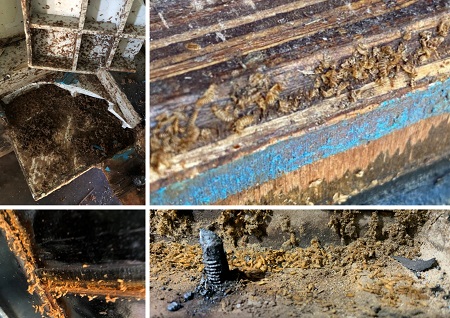
Measures for sea containers exported from khapra beetle target risk countries are detailed below. For a full list of import conditions refer to BICON. Failure to comply with the measures may result in the export of the goods and/or container on-arrival in Australia.
Measures may also apply to the goods within the container. Refer to the khapra beetle urgent actions webpage for more detail.
Full Container Load/Full Container Consolidated (FCL/FCX) containers packed with high-risk plant products in a khapra beetle target risk country must be treated offshore using an approved treatment option.
The container must be:
- treated prior to packing, except if using methyl bromide fumigation
- If using methyl bromide fumigation, the container can be treated when empty or when packed (provided it complies with our requirements)
- treated within 21 days prior to export
- accompanied by appropriate certification.
Failure to comply with these requirements will result in the export of the container upon arrival in Australia.
Important: The target of these treatments is the container and not the goods/commodity being shipped within the container. However, the goods may also need to be treated offshore. Learn more at: Urgent actions to protect against khapra beetle.
Sea containers packed in a non khapra beetle country are not subject to these requirements. A sealing declaration may be required to confirm the container’s packing location and, where relevant, to demonstrate that treatment was completed within 21 days prior to export. Refer to the sealing declaration supportive information section for further detail.
Note:
- ISO tanks, reefers (including non-operational), flat racks, LCL/FAKs and containers imported as empties are excluded from these requirements.
- Refer to the BICON case: Non-commodity cargo clearance for the full requirements.
- See the Summary Flowchart for an overview of these requirements.
Full Container Load/Full Container Consolidated (FCL/FCX) containers that are packed in a khapra beetle target risk country and will be unpacked in a rural khapra risk postcode of Australia (grain or nut growing areas, see postcode list) must be treated offshore using an approved treatment option.
The container must be:
- treated prior to packing, except if using methyl bromide fumigation
- If using methyl bromide fumigation, the container can be treated when empty or when packed (provided it complies with our requirements)
- treated within 21 days prior to export
- accompanied by appropriate certification.
Failure to comply with these requirements may result in the goods being directed for inspection, or the container being directed for treatment or export.
Important: The target of these treatments is the container and not the goods/commodity being shipped within the container. However, the goods may also need to be treated offshore. Learn more at: Urgent actions to protect against khapra beetle.
Sea containers packed in a non khapra beetle country are not subject to these requirements. A sealing declaration may be required to confirm the container’s packing location and, where relevant, to demonstrate that treatment was completed within 21 days prior to export. Refer to the sealing declaration supportive information section for further detail.
Note:
- ISO tanks, reefers (including non-operational), flat racks, LCL/FAKs, FCL containers of personal effects and containers imported as empties are excluded from these requirements.
- Refer to the BICON case: Non-commodity cargo clearance for the full requirements.
- For split postcodes, measures will apply to the rural areas of the postcode only. Postcode classifications can be found using the department’s postcode classification search tool.
- For containers destined for unpack in a rural location (including khapra risk postcodes), a rural tailgate inspection is still required.
Download
Rural khapra risk areas (PDF 223 KB)
Rural khapra risk areas (DOCX 70 KB)
If you have difficulty accessing these files, visit web accessibility for assistance.
Amendments to khapra beetle target-risk countries and Trogoderma species list
On 30 April 2026, we updated the ‘List of Target-risk Countries for Host of Khapra Beetle’ to add the following 7 countries: Angola, Chad, Guinea, Jordan, Kazakhstan, Tajikistan, and Tanzania.
Trogoderma serraticorne was also removed from the ‘List of Trogoderma species of Biosecurity Concern’.
These updates are based on recommendations of the Draft Pest Risk Analysis (PRA) for khapra beetle. For more information, refer to the following Import Industry Advice Notice: 64-2026: Commencement of updates to Lists for ‘Khapra beetle target risk countries’ and ‘Trogoderma Species of Biosecurity Concern'.
Pre-export treatment phytosanitary changes
On 28 May 2025, we updated the pre-export treatment and phytosanitary certification requirements for high-risk plant products and sea containers subject to khapra beetle measures.
Key changes implemented:
- Revised wording for gas permeable packaging additional declarations
- New NPPO supervision requirement and additional declaration for treatments undertaken by a provider that is listed as suspended, under review, withdrawn or unacceptable on our lists of registered and unregistered treatment providers
- Removal of the fourth concentration sampling tube for container fumigation treatments.
For more information, refer to the Import Industry Advice Notice: 165-2025: Revised conditions for offshore treatments and certification for khapra beetle now in effect.
We introduced khapra beetle urgent actions in 2020. Since then, we have seen a sustained reduction in the number of khapra beetle detections.
We are currently drafting a pest risk analysis on khapra beetle for the sea container pathway. This will review the urgent actions to ensure they are fit-for-purpose and technically justifiable and may lead to refinement of existing measures or identification of alternative measures to address the risk.
We will also continue to engage with the international community to lobby for:
- improvements to sea container design
- implementing improved hygiene standards.
The khapra beetle target risk countries are listed below.
- Afghanistan
- Albania
- Algeria
- Angola
- Bangladesh
- Benin
- Burkina Faso
- Chad
- Côte d’Ivoire (Ivory Coast)
- Cyprus
- Egypt
- Ghana
- Greece
- Guinea
- India
- Iran Islamic Republic of
- Iraq
- Israel
- Jordan
- Kazakhstan
- Kuwait
- Lebanon
- Libya
- Mali
- Mauritania
- Morocco
- Myanmar
- Nepal
- Niger
- Nigeria
- Oman
- Pakistan
- Qatar
- Saudi Arabia
- Senegal
- Somalia
- South Sudan
- Sri Lanka
- Sudan
- Syrian Arab Republic
- Tajikistan
- Tanzania
- Timor-Leste
- Tunisia
- Türkiye
- United Arab Emirates
- Yemen
Approved treatment options
The approved treatment options for target risk containers are detailed below.
Treatment rate
The container must be fumigated offshore with methyl bromide at
- a dose of 80 g/m³ or above, at 21°C or above, for a minimum of 48 hours, with an end point reading of 20 g/m³ or above OR
- a dose of 88 g/m³ or above, at 16°C or above, for a minimum of 48 hours, with an end point reading of 22 g/m³ or above OR
- a dose of 96 g/m³ or above, at 11°C or above, for a minimum of 48 hours, with an end point reading of 24 g/m³ or above OR
- a dose of 104 g/m³ or above, at 10°C or above, for a minimum of 48 hours, with an end point reading of 26 g/m³ or above.
Note: Dose increases to compensate for temperatures less than 10°C are NOT permitted.
Treatment requirements
The fumigations/treatments must comply with the following requirements:
- All treatments must be conducted in a gas-tight chamber or sheeted enclosure, with both container doors fully open.
- All treatments must be conducted in accordance with the Methyl Bromide Fumigation Methodology.
- All treatments must be conducted by a permitted treatment provider.
Treating the container and the goods at the same time
For methyl bromide treatments, containers may be treated at the same time as goods/commodities, after the goods/commodities have been loaded into the container. These treatments must still comply with the treatment requirements outlined above.
If the commodity being imported also requires methyl bromide treatment, one treatment can be conducted to meet both the container and the commodity treatment conditions, provided the commodity meets the consignment suitability requirements of the Methyl Bromide Fumigation Methodology, including gas permeable packaging requirements. To meet both sets of conditions, the highest treatment parameter of each rate must be met.
This includes the:
- dose
- start point concentration
- temperature
- exposure period
- end point concentration reading.
For example, if one treatment was conducted to meet the import conditions for a target risk container AND timber pallets, the highest parameter out of the two treatment rates would need to be met.
Worked example with highest parameter bolded:
| Target of fumigation | Dose | Temperature | Exposure period | End point concentration |
|---|---|---|---|---|
| Container | 80 g/m³ or above | 21°C or above | minimum of 48 hours | 20 g/m3 or above |
| Timber pallets | 48 g/m3 or above | 21°C or above | minimum of 24 hours | 14.4 g/m3 or above |
This means that the final rate applied to combined container and timber packaging treatment would be:
- fumigated with a dose of 80 g/m³ or above, at 21°C or above, for a minimum of 48 hours, with an end point reading of 20 g/m3 or above.
Note: Fumigation of the container and goods at the same time may not be an option in some instances. See Urgent actions to protect against khapra beetle webpage for more detail.
Permitted treatment providers
| Country of treatment | Permitted treatment providers |
|---|---|
| AFAS countries (includes Sri Lanka & India) | The treatment must be conducted by an AFAS-registered treatment provider who:
OR
Note: These conditions apply to target risk containers that are transhipped from a khapra beetle target risk country through an AFAS country for treatment. |
All other khapra beetle target risk countries (except for Sri Lanka & India) | The treatment must be conducted by a treatment provider who:
OR
OR
|
Note: We are utilising the department’s existing offshore treatment provider assurance schemes to manage the registration and compliance of treatment providers, where possible. Leveraging these schemes will provide us with a greater level of assurance of treatment providers’ ability to conduct the required treatments. This includes both the Australian Fumigation Accreditation Scheme (AFAS) and the AusTreat pre-border biosecurity treatment provider scheme. It is strongly recommended that treatments are conducted by a treatment providers approved under one of the department's offshore treatment provider schemes.
Treatment infographic
The following treatment infographics have been developed for your use. Help us keep khapra beetle out of Australia by sharing them with your networks.
Download
Methyl bromide treatment requirements (PDF 202 KB)
Methyl bromide treatment requirements (DOCX 52 KB)
Infographic: Methyl bromide fumigation of high-risk plant products: packaging requirements (PDF 3.48 MB)
Infographic: Methyl bromide fumigation of high-risk plant products: packaging requirements (DOCX 254 KB)
Infographic: Khapra beetle methyl bromide treatment scenarios for goods containers (PDF 371 KB)
Infographic: Khapra beetle methyl bromide treatment scenarios for goods containers (DOCX 258 KB)
If you have difficulty accessing these files, visit web accessibility for assistance.
Treatment rate
The container must be heat treated offshore to at least 60°C for a minimum of 180 minutes.
Treatment requirements
The heat treatment must be conducted:
- in accordance with the Heat Treatment Methodology
- prior to loading the goods/commodity into the container
- in a sheeted enclosure, with one container door open and one container door closed
- with at least one of the temperature sensors positioned within the door hinge of the door that is closed, in the bottom corner underneath the rubber seal
- by a permitted treatment provider.
Note: While the effective heat treatment rate for all life stages of khapra beetle is 60°C for a minimum of two hours, we require three hours to heat treat containers because:
- khapra beetle is often detected between the floorboards and bottom metal rails of sea containers
- in a trial we conducted we found these areas can take longer to reach 60°C than other areas in the container
- it is difficult to position temperature sensors in this area without drilling into the container floor
- in our trial, we also determined that the temperature within the door hinge of the closed door underneath the rubber seal was a suitable proxy for the underfloor area of the container, provided that target temperature was achieved for an additional hour.
Permitted treatment providers
| Country of treatment | Permitted treatment providers |
|---|---|
| All countries | The treatment must be conducted by a treatment provider who:
OR
OR
|
Note: We are utilising our existing offshore treatment provider assurance schemes to manage the registration and compliance of treatment providers, where possible. Leveraging these schemes will provide us with a greater level of assurance of treatment providers’ ability to conduct the required treatments. This includes both the Australian Fumigation Accreditation Scheme (AFAS) and the AusTreat pre-border biosecurity treatment provider scheme. It is strongly recommended that treatments are conducted by a treatment providers approved under one of the department's offshore treatment provider schemes.
Treatment infographic
The following treatment infographics have been developed for your use. Help us keep khapra beetle out of Australia by sharing them with your networks.
Download
Heat treatment requirements (PDF 156 KB)
Heat treatment requirements (DOCX 51 KB)
If you have difficulty accessing these files, visit web accessibility for assistance.
Insecticide spray with a product containing the active constituent deltamethrin will be offered as a provisional treatment option only. This means that non-compliance will be monitored closely and will inform the longevity of this treatment method.
As this is a provisional measure, we are strongly encouraging industry to use methyl bromide fumigation or heat treatment over an insecticide spray.
Treatment rate
Prior to packing, the following areas of the sea container must be treated with a suspension concentrate formulated insecticide product, containing the active constituent deltamethrin:
- the internal and external underside of the floor
- the internal and external lower portion of the three walls and doors up to 1m
- the door seals.
The treatment must be applied at a rate of 1 litre spray solution, with a concentration of 0.03% or above, per 20m2, applied as a coarse spray of 350 to 400 microns.
Treatment requirements
The insecticide treatment must be conducted in accordance with the Insecticide Treatment Methodology.
Note: To avoid potential contamination of the products with insecticide, importers should line the interior of the sea container and bag the products.
It is the importer's responsibility to ensure that all imported food complies with the Imported Food Control Act 1992 including Australia New Zealand Food Standards Code; and that imported animal and pet food complies with the Agricultural and Veterinary Chemicals Code (MRL Standard) Instrument 2019.
Permitted treatment providers
| Country of treatment | Permitted treatment providers |
|---|---|
| All countries |
|
Treatment infographic
The following treatment infographics have been developed for your use. Help us keep khapra beetle out of Australia by sharing them with your networks.
Download
Insecticide spray treatment requirements (PDF 193 KB)
Insecticide spray treatment requirements (DOCX 51 KB)
If you have difficulty accessing these files, visit web accessibility for assistance.
Treatment certificates for sea container treatments must meet the department’s minimum requirements, as set out in the relevant BICON cases and the relevant treatment methodology. Treatment certificate templates for each treatment are available via the following links:
Notes:
- All treatment providers that are registered with the department will be assigned an AEI number.
- Further information for custom brokers on the use of AEIs for certificates covering khapra beetle sea container treatments can be found on our AEI webpage.
- If a phytosanitary certificate is provided, a treatment certificate issued in accordance with the above requirements is still required.
- We encourage treatment providers to use our treatment certificate templates to ensure they are compliant, which will facilitate clearance of sea containers.
Download
Amended methyl bromide fumigation treatment certificate requirements (DOCX 74 KB)
If you have difficulty accessing these files, visit web accessibility for assistance.
Supportive information
Additional information is provided below.
A sealing declaration may be required in some instances. Ensure you use the sealing declaration template.
Download
Sealing declaration template (PDF 45 KB)
Sealing declaration template (DOCX 39 KB)
If you have difficulty accessing these files, visit web accessibility for assistance.
1. To demonstrate that khapra measures do not apply to a container
As outlined in the summary flowchart, a sealing declaration is required for certain containers to confirm the packing location. For example, sea containers that are packed in a non-khapra beetle country (i.e. containers packed with high-risk plant products or containers destined for a rural khapra risk area of Australia) but:
- the port of loading country is listed as a khapra beetle target risk country on the Bill of Lading; OR
- the supplier/exporter/consignor/shipper is listed as being from a khapra beetle target risk country on the Bill of Lading.
2. To demonstrate that a container has been treated within 21 days prior to export
The date of export is defined in the Minimum documentary and import declaration requirements policy. Under this definition, a consignment is considered to be exported either:
- when it is lodged with the freight forwarder, shipping company/airline, charter operator or an appointed agent in the country of origin, for ultimate destination in Australia
- when it is shipped on board the vessel
- when it is packed in a container and sealed in preparation for export.
As an example, if the container is packed and sealed within 21 days of treatment, the container meets the treatment within 21 days of export requirement. To demonstrate that this requirement has been met a sealing declaration is required. Please refer to the section 9.1 of the Minimum documentary and Import declaration requirements policy for guidance on other options to provide documentary evidence to demonstrate the date of export.
The khapra beetle in-transit policy will apply to containers impacted by the requirements for sea containers.
This means that if a treatment provider is listed as suspended, unacceptable, withdrawn or under review, all treatment certification issued by them are considered unacceptable from the date of their change in status.
The date of change in status is the date published on our website, regardless of the date of treatment or the date of issue on the certificate. This includes certification issued both before and after the change in their status, for goods that have not yet been cleared through the border. In this situation, containers may be subject to on-wharf risk containment measures prior to onshore treatment using methyl bromide. Both the goods and the container will require treatment and de-consolidation of the container will generally not be permitted.
Sea container measures summary flowchart
Download
Sea container measures summary flowchart (PDF 186 KB)
Sea container measures summary flowchart (DOCX 51 KB)
If you have difficulty accessing these files, visit web accessibility for assistance.
Check if your container needs to comply with the khapra beetle sea container measures using the below flowchart.
Note: If you require a sealing declaration (as per the flowchart), ensure you use the sealing declaration template.
Posters
Poster: Seven tips for keeping containers clean
Download
English Poster: 7 tips for keeping containers clean (PDF 152 KB)
English Poster: 7 tips for keeping containers clean (DOCX 47 KB)
Arabic Poster: 7 tips for keeping containers clean (PDF 117 KB)
Arabic Poster: 7 tips for keeping containers clean (DOC 70 KB)
Chinese Simplified Poster: 7 tips for keeping containers clean (PDF134 KB)
Chinese Simplified Poster: 7 tips for keeping containers clean (DOC 50 KB)
Chinese Traditional Poster: 7 tips for keeping containers clean (PDF143 KB)
Chinese Traditional Poster: 7 tips for keeping containers clean (DOC 50 KB)
French Poster: 7 tips for keeping containers clean (PDF 160 KB)
French Poster: 7 tips for keeping containers clean (DOC 67 KB)
Russian Poster: 7 tips for keeping containers clean (PDF 139 KB)
Russian Poster: 7 tips for keeping containers clean (DOC 55 KB)
Spanish Poster: 7 tips for keeping containers clean (PDF 156 KB)
Spanish Poster: 7 tips for keeping containers clean (DOC 69 KB)
If you have difficulty accessing these files, visit web accessibility for assistance.
Reporting and onshore assessment requirements
The following infographics have been developed for your use. They detail AEI reporting and onshore assessment requirements.
Download
AEI reporting requirements for khapra beetle sea container treatments (PDF 278 KB)
AEI reporting requirements for khapra beetle sea container treatments (DOCX 57 KB)
Khapra beetle sea container measures: Onshore assessment (PDF 395 KB
Khapra beetle sea container measures: Onshore assessment (DOCX 56 KB)
If you have difficulty accessing these files, visit web accessibility for assistance.
Sea container cleanliness video
What does a snail almost the size of a dinner plate, a beetle smaller than a grain of rice, and an ant with a fiery sting have in common? They are all excellent hitchhiker pests!
Keeping sea containers clean is critical to stopping the spread of hitchhiker pests. Learn how you can help us fight the battle against hitchhiker pests.
Sea container cleanliness video
Download transcript
Video transcript - Sea container cleanliness (DOCX 37 KB)
If you have difficulty accessing these files, visit web accessibility for assistance.
Sea container cleanliness video: Chinese (Mandarin) translation
Translation courtesy of Shenzhen Academy of Inspection and Quarantine, China.
Download transcript
Video transcript - Sea container cleanliness: Chinese (Mandarin) translation (DOCX 230 KB
If you have difficulty accessing these files, visit web accessibility for assistance.
See. Secure. Report.
If you suspect you have seen khapra beetle or anything unusual please report it, even if you are not sure.
Get in touch
If you:
- want to import plant products into Australia, it is important that you check BICON
- want to receive updates on the implementation of the urgent actions register to receive BICON alerts and IANs.
For:
- questions and information related directly to offshore khapra treatments, please email offshoretreatments@aff.gov.au
- any further questions, please contact us on 1800 900 090 or via email SPP@aff.gov.au (please title the subject line of the email with ‘Plant Tier 2 – Khapra urgent actions’).