

Key issues
- In the week ending 25 November 2026, low-pressure troughs brought storms to much of the east and north. Much of the remainder of Australia was comparatively dry.
- Many New South Wales cropping regions saw between 10-100 millimetres of rainfall over the period, with lower falls of 5-50 millimetres recorded across must Queensland and Victorian cropping regions.
- In Queensland, drier conditions compared to the previous week are expected to facilitate field access for summer crop planting and winter crop harvest activities. However, heavy falls across New South Wales and southern Victoria are likely to have led to harvest delays.
- Over the eight days from 26 November to 3 December 2026, rainfall is forecast across much of the eastern two-thirds of Australia. Much of Western Australia is likely to remain dry.
- Across eastern cropping regions, falls are expected to be considerable, with falls of up to 100 millimetres across Queensland, New South Wales, and Victoria.
- If realised, these falls are likely to continues to support pasture growth and development of summer crops already in the ground in Queensland and northern New South Wales but are likely to delay the further planting of summer crops. These falls are also likely to further delay winter crop harvest activities and increase the risk of grain quality downgrades due to excess moisture at harvest.
- Despite the strong El Niño, the Bureau of Meteorology’s December 2026 to February 2027 outlook indicates below average rainfall is likely be restricted to the northern tropics. Above average rainfall is more likely across parts of eastern and central Australia.
- If forecast December to February rainfall totals are realised, they are likely to support at least average pasture growth across much of eastern and northern Australia. In Queensland and north-eastern New South Wales, forecast rainfall will aid late summer crop planting opportunities and support the growth and yield potential of early planted summer crops.
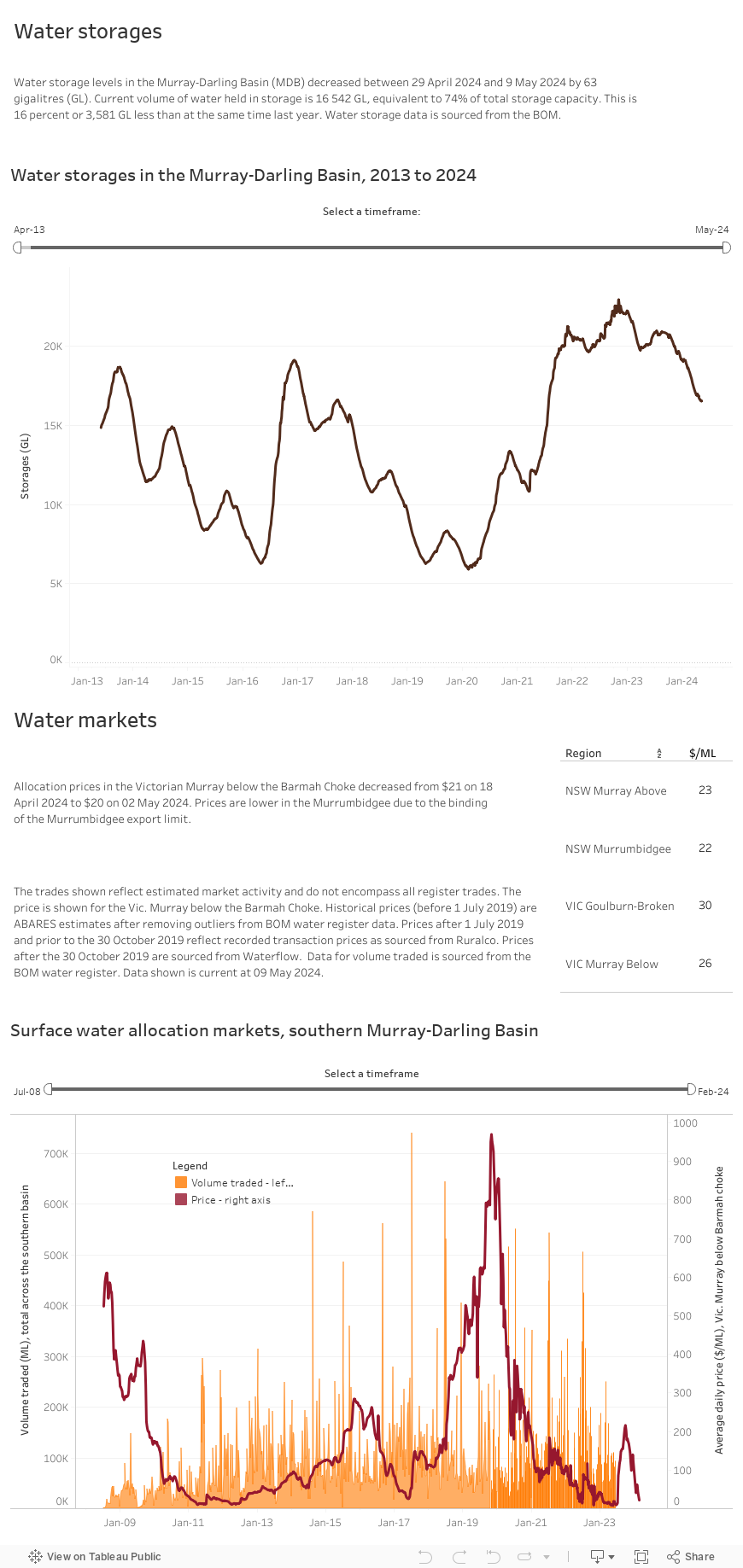
- Water storage levels in the Murray-Darling Basin (MDB) decreased by 27 gigalitres (GL) between 19 November 2026 and 26 November 2026. The current volume of water held in storages is 14,685 GL, equivalent to 66% of total storage capacity. This is 2% or 320 GL more than the same time last year. Water storage data is sourced from the Bureau of Meteorology (BOM).
- Allocation prices in the Victorian Murray below the Barmah Choke decreased from $279/ML on 12 November 2026 to $255/ML on 19 November 2026. Trade from the Goulburn to the Murray is closed. Trade downstream through the Barmah Choke is closed. Trade from the Murrumbidgee to the Murray is closed.
Full report
Weekly Australian Climate, Water and Agricultural update
Read the full report for the week ending 26 November 2026
If you have difficulty accessing these files, contact us for help.
Water
Water storages, water markets and water allocations - current week
The Tableau dashboard may not meet accessibility requirements. For information about the contents of these dashboards contact ABARES.
Commodities
Information on weekly price changes in agricultural commodities is now available at the Weekly commodity price update.