
Download full report and data
The Australian Crop Report contains ABARES forecasts for the area, yield and production of Australia’s major winter and summer broadacre crops. Forecasts are made at the Australian state level.
Download the full report
- Australian Crop Report: September 2026 No. 219 (PDF - 851 KB)
- Australian Crop Report: September 2026 No. 219 (Word - 4.62 MB)
Download the data
Email us at info.abares@aff.gov.au if you are having difficulties accessing or downloading these files.
Key points
- The 2026–27 winter cropping season has improved throughout winter with timely rainfall in most southern cropping regions.
- National winter crop production to fall by 12% in 2026–27 to 61 million tonnes, still the fourth largest crop on record.
- National summer crop production forecast to fall by 25% to 3.4 million tonnes in 2026–27, 11% below the 10-year average.
Above average national winter crop production
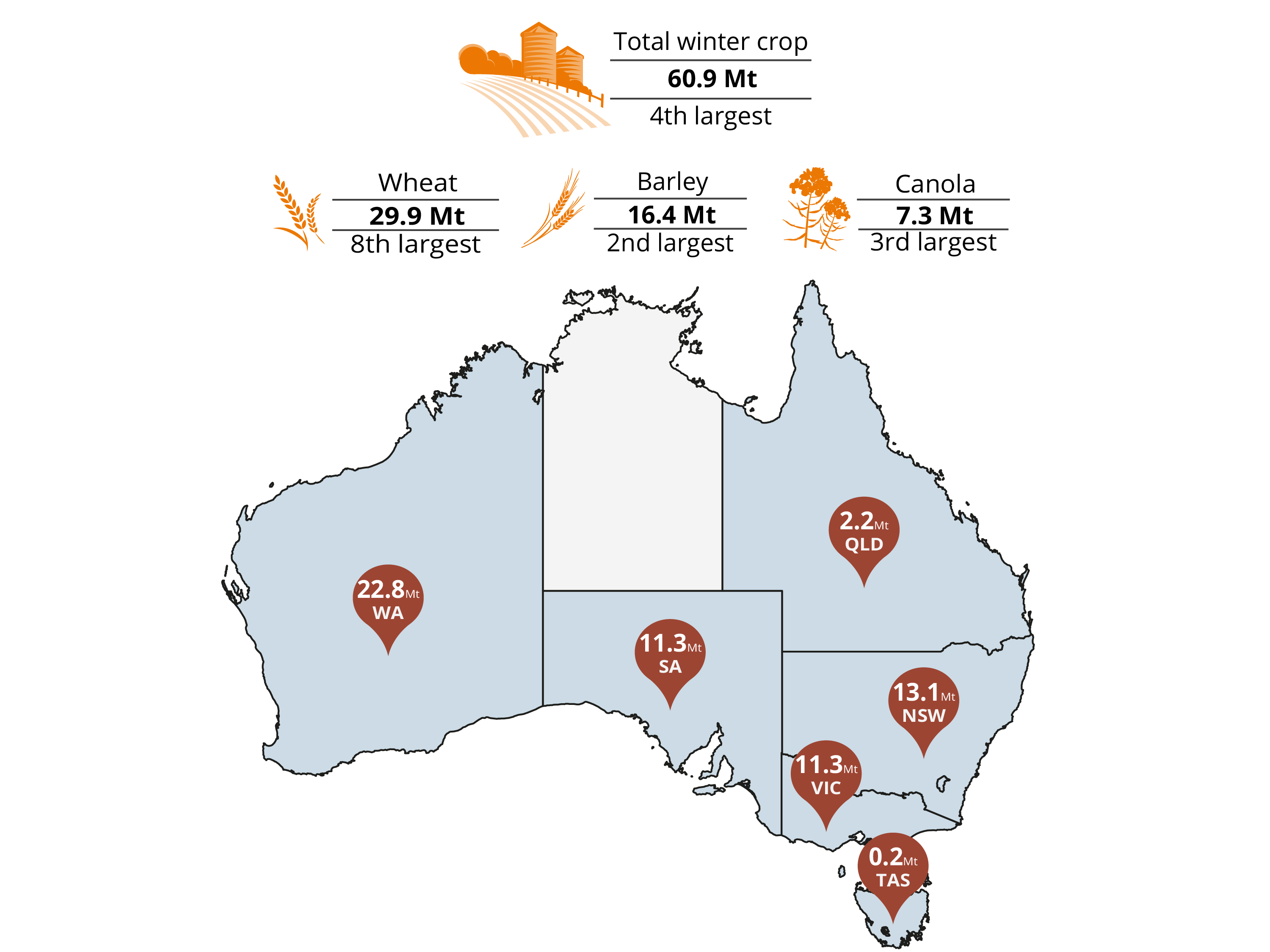
Australian winter crop production is forecast to fall by 12% to 61 million tonnes in 2026–27 (Figure 1). This is 16% above the 10-year average to 2025–26 and if realised, would be the fourth largest on record. This forecast reflects excellent growing conditions in South Australia, Victoria and southern New South Wales, being more than offset by closer to average conditions in Western Australia and poor conditions northern New South Wales and Queensland. Despite the below average winter rainfall outlook in May, seasonal conditions throughout winter have been much better than expected, boosting production prospects across most major southern cropping regions.
- After an excellent start to the season in Western Australia, South Australia, Victoria and southern New South Wales most crops were sown within the ideal planting window into above average soil moisture. Above average May-July rainfall in South Australia and Victoria, along with mild temperatures has resulted in early emergence and establishment of crops. This has resulted in the maturity of most crops being 3-4 weeks early, with well above average yield potential.
- Conditions have been largely favourable in Western Australia and southern and central New South Wales. However, below average July rainfall in Western Australia has placed crops under some moisture stress, with most regions receiving just enough rainfall to maintain growth. Limited stored subsoil moisture means that further rainfall during August and September will be crucial for current yield potential to be realised.
- By contrast, conditions in northern New South Wales and most of Queensland are poor with a significant decline in the area planted and below average yield expectations. Despite receiving above average rainfall in May, it was not enough to offset the moisture deficit in many cropping regions, which have received limited follow up rainfall.
- Despite significant uncertainty around the price and availability of fuel and fertiliser at the start of the season, it has not resulted in any significant impacts on production potential, with growers able to access inputs, albeit often at a higher price. Growers in some regions have prioritised fertiliser application on canola at the expense of cereals but this is not expected to have a significant impact on total production volume, with seasonal conditions driving expected production outcomes.
According to the latest three-month rainfall outlook (September to November), issued by the Bureau of Meteorology on 20 August 2026, there is a 25% to 55% chance of exceeding median rainfall across cropping regions in Queensland and New South Wales, with the lowest probabilities evident in southern New South Wales and eastern Queensland. Victoria has a 20% to 40% chance of exceeding median rainfall, while South Australia has a 20% to 55% chance. In Western Australia southwest cropping regions have a 25% to 40% chance of exceeding median rainfall, while southeast and northern cropping regions have an increased chance of exceeding median rainfall (between 45% and 75%).
National winter crop production has been revised up 12% compared to the June 2026 Australian crop report. This reflects better than expected conditions in most southern cropping regions with upwards revisions for all major winter crops from the June forecast.
- Wheat production is forecast to fall by 17% to 29.9 million tonnes in 2026–27, largely reflecting an 11% decrease in the area planted. This would still be 3% above the 10-year average to 2025–26.
- Barley production is forecast to fall by 3% to 16.4 million tonnes in 2026–27, 30% above the 10-year average to 2025–26, with the area planted to barley estimated to be up 6% year on year.
- Canola production is forecast to decrease by 5% to 7.3 million tonnes in 2026–27, despite a 2% increase in the area sown, largely reflecting lower yields in Western Australia. This would still be 37% above the 10- year average to 2025–26.
- Lentil production is forecast to increase by 5% to a second consecutive record of 2.3 million tonnes in 2026–27, more than double the 10-year average to 2025–26. This reflects continued expansion in area planted and excellent conditions in major growing regions of South Australia and Victoria.
- In contrast, Chickpea production production is forecast to fall by 52% to just over 1 million tonnes in 2026–27, with significant cuts to area planted and expected lower yields in major growing regions of northern New South Wales and Queensland.
Figure 1 Australian winter crop production, 2026–27
Source: ABARES
Summer crop outlook uncertain
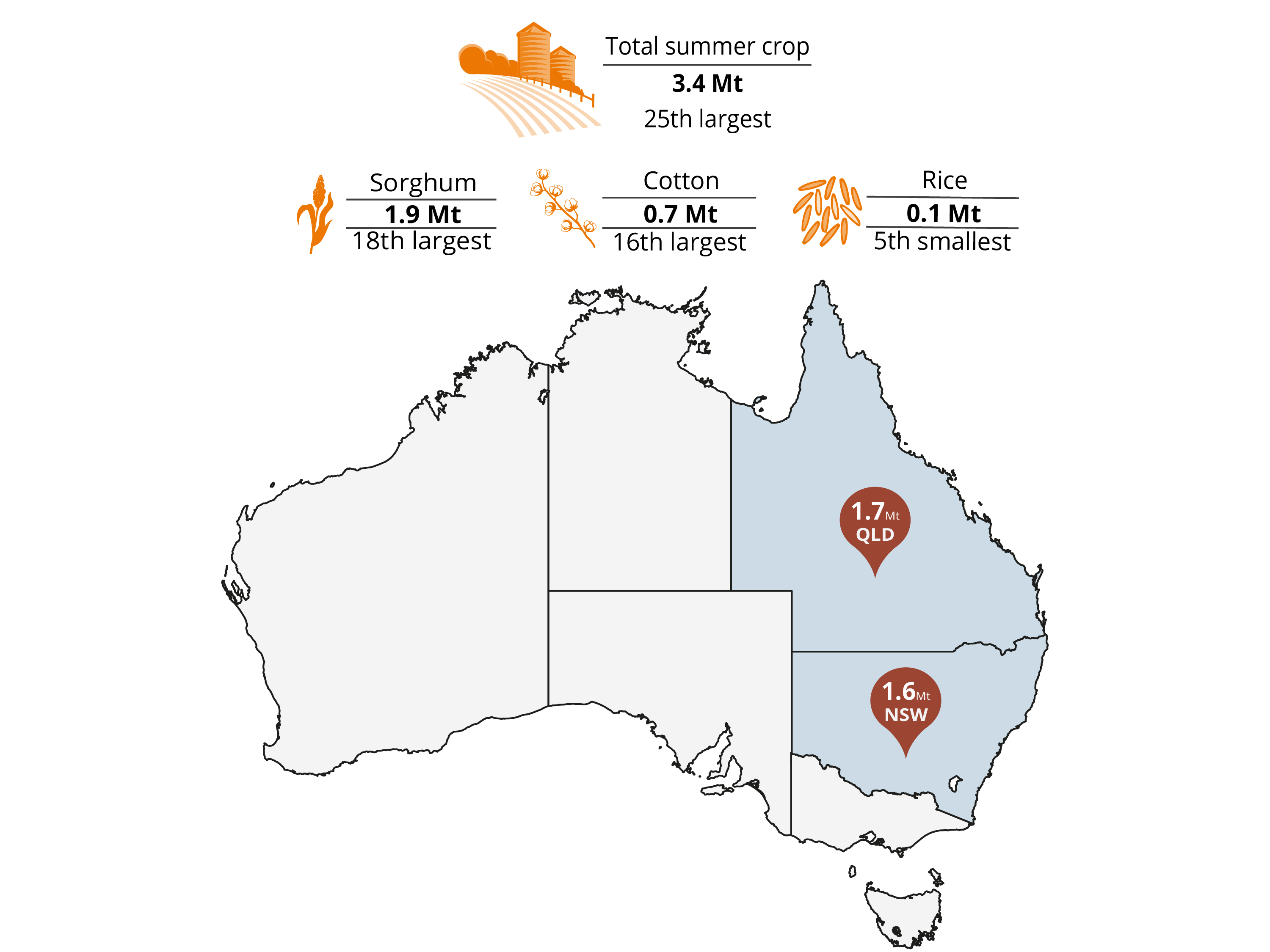
At this early stage, the area planted to summer crops in 2026–27 is forecast to fall 17% to 1.1 million hectares. The expected fall is being driven by below average soil moisture levels in late winter, low irrigation water availability and a relatively neutral chance of exceeding above average spring rainfall across key summer cropping regions. Summer crop production is forecast to fall by 25% in 2026–27 to 3.4 million tonnes, 11% below the 10-year average to 2025–26.
Sorghum production is forecast to fall by 26% to just over 1.9 million tonnes in 2026–27. Area planted to sorghum is forecast to fall by 9% to 592 thousand hectares but remain 12% above the 10-year average to 2025–26. The fall in area reflects below average soil moisture and expected dry conditions in the lead up to the planting window. If rainfall is better than expected, there is potential for the area planted to be higher, with a significant amount of fallow area available in major cropping regions where winter crops were not planted.
Production of cotton lint is forecast to fall by 34% to 697 thousand tonnes in 2026–27, reflecting a reduction in planted area and lower yields. Area planted to cotton is forecast to fall by 34% to 301 thousand hectares in 2026–27, largely reflecting decreased availability of irrigation water and dry seasonal conditions.
Rice production is forecast to fall by 22% to just 139 thousand tonnes in 2026–27, driven by a further fall in the area planted from the previous seasons low level. Low water availability across the Murray-Darling basin has resulted in an increase in the price of irrigation water, which is expected to constrain the area planted to rice.
Figure 2 Australian summer crop production, 2025–26
Source: ABARES
Crop forecasts by state
Winter crop production in Queensland is forecast to fall by 44% to 2.2 million tonnes in 2026–27. The fall reflects a year-on-year fall in area planted and lower expected yields for most winter crops. This is expected to be 11% below 10-year-average to 2025–26 and represent a 9% downward revision from the June 2026 Australian Crop Report, reflecting limited stored soil moisture levels at planting and below average to average rainfall during the growing season to date.
Area planted to winter crops in Queensland in 2026–27 is estimated to fall by 24% to 1.2 million hectares, 4% below the 10-year average to 2025–26. Area planted to wheat is expected to fall by 26%, 13% below the 10-year averages to 2025–26. Barley area is expected to fall by 11% but remain 2% above the 10-year-average. The smaller fall in area planted to barley reflects growers’ preference over wheat in drier conditions and concerns about fertiliser availability and pricing during planting. Area planted to chickpeas is also expected to fall by 25% in 2026–27, reflecting dry conditions across many planting regions in central and southern Queensland.
Winter crop yields are forecast to fall by 26% to around 1.8 tonnes per hectare in 2026–27, 1% below the 10-year average to 2025–26. The climate outlook (issued by Bureau of Meteorology on 20 Aug 2026) indicates that the chance of exceeding median rainfall is 30% to 55% across most of Queensland between September and November. Average to below average rainfall between May and July has meant soil moisture levels remained average to below average for most of Queensland during the growing season.
| Crop | Area '000 ha | Yield t/ha | Production kt | Area change % | Prod. change % |
|---|---|---|---|---|---|
| Wheat | 650 | 1.86 | 1,210 | -26.1 | -47.6 |
| Barley | 155 | 2.29 | 355 | -11.4 | -31.1 |
| Chickpeas | 380 | 1.50 | 570 | -24.8 | -41.5 |
Note:Yields are based on area planted. Area based on planted crop that was intended for grain or seed, and then harvested, fed off or failed. Percent changes are relative to 2025–26.
Source: ABARES
Summer crop production in Queensland is forecast to fall by 24% to 1.7 million tonnes in 2026–27. This is 2% below the 10-year average to 2025–26, as limited stored soil moisture and an average to below average rainfall outlook for spring across most of Queensland is expected to limit planting intentions. At this early stage, yields are expected to fall for most summer crops to around 10-year-average levels.
Sorghum production is forecast to fall by 25% to 1.3 million tonnes in 2026–27, reflecting lower area planted and yields. Expected falls in area planted largely reflect limited stored soil moisture and the reduced chance that this will be replenished prior to planting. The sorghum planting window in Queensland is quite wide, so there is a chance that a late plant could go in if sufficient rainfall is received.
Cotton lint production is forecast to fall by 27% to 254 thousand tonnes in 2026–27, driven by a fall in planted area and lower yields. Area planted to cotton is forecast to fall by 25% to 108 thousand hectares in 2026–27, 27% below the 10-year average to 2025–26. This reflects reduced irrigation water availability for irrigated cotton, limited stored soil moisture and an unfavourable spring rainfall outlook for dryland production.
| Crop | Area '000 ha | Yield t/ha | Production kt | Area change % | Prod. change % |
|---|---|---|---|---|---|
| Grain sorghum | 400 | 3.25 | 1,300 | -11.1 | -24.6 |
| Cotton lint | 108 | 2.36 | 254 | -25.1 | -27.0 |
| Cottonseed | 108 | 2.70 | 291 | -25.1 | -27.0 |
Note: Yields are based on area planted, except cotton which is based on area harvested. Area based on planted crop that was intended for grain or seed, and then harvested, fed off or failed. Percent changes are relative to 2025–26.
Source: ABARES
Winter crop production in New South Wales is forecast to decrease by 30% to 13.1 million tonnes in 2026–27, 3% below the 10-year average to 2025–26. This represents a 12% upward revision from the June 2026 Australian Crop Report. A dry start to the winter cropping season in northern New South Wales, combined with low winter rainfall has resulted in a reduction in area planted to winter crops and low yields in the north of the state heading into spring. Conditions in parts of central and southern New South Wales have been more favourable, with sufficient soil moisture around planting and adequate rainfall throughout winter supporting higher yields.
Winter crop yields are currently forecast to average 2.3 tonnes per hectare in 2026–27, 6% above the 10-year average to 2025–26. This reflects dry conditions in the north of the state being partially offset by favourable growing conditions in parts of central and southern New South Wales. Currently winter crops in southern New South Wales are more advanced than normal as mild temperatures throughout June and July have supported crop growth. This could provide a downside risk to yields if severe frost events were to occur in southern growing regions throughout late winter and early spring.
The September to November climate outlook, issued by the Bureau of Meteorology on 20 August 2026, indicates a strong tendency towards below average rainfall for southern cropping regions in New South Wales. Yield prospects in southern cropping regions will be reliant on adequate and timely rainfall to realise current yield potential. In contrast, well below average soil moisture levels across much of northern New South Wales leading into spring, combined with an average to below average spring rainfall outlook, are expected to significantly reduce yield prospects.
Area planted to winter crops in New South Wales is estimated to have fallen by 19% in 2026–27 to 5.7 million hectares, 2% below the 10-year average to 2025–26. The area planted to wheat is estimated to be down 17% year-on-year, 8% below the 10-year average to 2025–26. Barley area is estimated to have fallen by 5% year-on-year to 1 million hectares. Growers have prioritised barley plantings over wheat on a margin’s basis due to the dry climate outlook and concerns about fertiliser availability at the time of planting. Area planted to canola is estimated to be down 25% year-on-year, reflecting very dry conditions during autumn in northern cropping regions of New South Wales.
| Crop | Area '000 ha | Yield t/ha | Production kt | Area change % | Prod. change % |
|---|---|---|---|---|---|
| Wheat | 3,000 | 2.57 | 7,700 | –16.7 | –31.1 |
| Barley | 1,050 | 2.76 | 2,900 | –4.5 | –19.4 |
| Canola | 710 | 1.69 | 1,200 | –25.3 | –25.0 |
| Chickpeas | 345 | 1.30 | 450 | –46.9 | –61.9 |
Note: Yields are based on area planted. Area based on planted crop that was intended for grain or seed, and then harvested, fed off or failed. Percent changes are relative to 2025–26.
Source: ABARES
Summer crop production in New South Wales in 2026–27 is forecast to fall 28% to 1.6 million tonnes, 21% below the 10-year average to 2025–26. The expected fall in production reflects below average soil moisture in key northern cropping regions and low irrigation water availability. At this early stage, yields are not expected to be to be as high as the levels seen in 2025–26 for most summer crops.
Sorghum production production is forecast to fall by 29% to 600 thousand tonnes in 2026–27, 5% above the 10-year average to 2025–26. The area planted is forecast to fall by 5% to 190 thousand hectares. Low soil moisture during winter crop sowing has meant that many growers in sorghum growing regions left fields fallow over winter. If spring rainfall is better than expected, it is possible that those growers who forewent a winter crop will plant sorghum. At this early stage, average yields are forecast to be below last season.
Cotton lint production is estimated to fall by 40% to 389 thousand tonnes in 2026–27, largely reflecting lower area planted to cotton. Low carryover water from 2025–26 and below average allocations are expected to drive lower irrigated planting. Dryland planting is also expected to fall to well below average, reflecting low levels of soil moisture in key cotton growing regions in northern New South Wales.
Rice production is estimated to fall by 22% to 137 thousand tonnes in 2026–27, driven by a 18% decrease in the area planted. Ongoing dry conditions have resulted in a decline in water availability across the southern Murray-Darling basin and an increase in the price of irrigated water, which is likely to constrain the area planted to rice.
| Crop | Area '000 ha | Yield t/ha | Production kt | Area change % | Prod. change % |
|---|---|---|---|---|---|
| Grain sorghum | 190 | 3.16 | 600 | –5.0 | –28.6 |
| Cotton lint | 171 | 2.27 | 389 | –41.2 | –40.2 |
| Cottonseed | 171 | 2.60 | 446 | –41.2 | –40.2 |
| Rice | 14 | 9.80 | 137 | –17.6 | –21.6 |
Note: Yields are based on area planted, except cotton which is based on area harvested. Area based on planted crop that was intended for grain or seed, and then harvested, fed off or failed. Percent changes are relative to 2025–26.
Source: ABARES
Winter crop production in Victoria is forecast to reach 11.3 million tonnes in 2026–27, up 12% from 2025–26. Excellent seasonal conditions have boosted production prospects, with winter crop production now expected to be 28% above the 10-year average of 8.9 million tonnes. This represents an 18% upward revision from the June 2026 Australian Crop Report and would be marginally higher than the previous record set in 2022–23.
Despite a relatively dry April, soil moisture availability was above average in Victoria following well above average rainfall in February and March. Crops were sown during the ideal planting window into moisture and have received average to above average May to August rainfall across most cropping regions. Combined with mild winter temperatures, crop establishment and growth are well advanced with crops around 3-4 weeks ahead of where they would normally be at this stage in the season. Despite the decreased chances of receiving above average rainfall during spring, crops are well positioned to withstand forecast below average rainfall until harvest and in some cases would benefit from a dry spell. There is an increased risk that a significant frost event could impact yields due to how advanced crops are, but above average soil moisture availability should mitigate some of that risk.
According to the latest three-month rainfall outlook (September to November), issued by the Bureau of Meteorology on 20 August 2026, rainfall is not likely to exceed median levels across most cropping regions in Victoria. Below average forecast rainfall is not likely to impact crops significantly due to current soil moisture reserves and the advance stage that crops are in heading into spring.
The average wheat yield is forecast to increase by 18% to 3.4 tonnes per hectare, 20% above the 10-year average, reflecting early planting into moisture and ideal growing conditions to date. The average barley yield is forecast to be similar to last year’s strong result at 3.6 tonnes per hectare, 25% above the 10-year average. The average canola yield is forecast to increase by 6% to 2.45 tonnes per hectare.
Area planted to winter crops in Victoria in 2026–27 is estimated to have increased by 3% to 3.8 million hectares, the highest area on record. This reflects the ideal start to the season across all cropping regions and the continued expansion of cropping area into areas previously grazed by livestock.
| Crop | Area '000 ha | Yield t/ha | Production kt | Area change % | Prod. change % |
|---|---|---|---|---|---|
| Wheat | 1,440 | 3.40 | 4,896 | –2.0 | 15.2 |
| Barley | 950 | 3.58 | 3,401 | 11.8 | 9.7 |
| Canola | 580 | 2.45 | 1,421 | 7.4 | 13.7 |
| Lentils | 533 | 1.75 | 933 | 0.6 | 0.8 |
Note:Yields are based on area planted. Area based on planted crop that was intended for grain or seed, and then harvested, fed off or failed. Percent changes are relative to 2025–26.
Source: ABARES
Winter crop production in South Australia is forecast to rise to 11.3 million tonnes in 2026–27 from 9.1 million tonnes in 2025–26. South Australia is experiencing one of the best growing seasons to date and production has been revised up by 24% from the June 2026 Australian Crop Report and is now forecast to be the second highest production year on record, following 2022–23.
Average to above average rainfall fell across many parts of South Australia's cropping regions in June and July which maintained strong upper- and lower-layer soil moisture following well above average February to May rainfall. Crops were sown into early season soil moisture and the follow up rainfall alongside mild winter temperatures has advanced the crops up to 4 weeks ahead of where they would normally be at this stage in the season.
The Bureau of Meteorology's latest climate outlook (September to November), released on 20 August 2025, indicates a 45-70% chance of below average rainfall across much of South Australia. Chances of exceeding median rainfall are the lowest in the Southeast and the lower Yorke and Eyre Peninsula, whereas the upper Eyre Peninsula, the Mallee and the Upper North have a higher chance of seeing close to median rainfall. In spring, there is also an 80% chance of exceeding the median maximum temperature across the state. Despite this dry and hot outlook, the exceptional condition and advanced development of most crops mean that they will that they will be more resilient to heat stress later in the season. While late frosts also continue to remain a threat, above average soil moisture is expected to limit additional downside risk to yield potential.
Winter crop yields are forecast to increase by 20% to 2.7 tonnes per hectare in 2026–27, with the average state yield second highest on record and 29% above the 10-year average to 2025–26. Wheat, barley and canola yields are all forecast to rise significantly, reaching 2.9 tonnes per hectare, 3.3 tonnes per hectare, and 2.3 tonnes per hectare respectively and are all the second highest on record following the record yields set in 2022–23. Significant upward revisions to yields from the June 2026 Australian Crop Report reflects the better-than-forecast winter rainfall which further boosted soil moisture and crop development following a strong season start.
The area planted to winter crops is estimated to have increased by 4% to 4.1 million hectares which is the third largest area on record and 9% above the 10-year average to 2025–26. Area planted has increased across all major crops, reflecting the very favourable start to the season. Wheat area is estimated to have increased by 3% to 2.05 million hectares and barley area estimated to have increased by 5% to 880 thousand hectares. While barley was favoured over wheat at the start of the season due to strong gross margins and lower input requirements, wheat area has also increased reflecting the overall cropping area growth, particularly in the Murray and Mallee regions. Lentil area is forecast to rise by 3% to 600 thousand hectares, and canola area is estimated to have increased by 12% to 280 thousand hectares. Due to the significant moisture availability and strong gross margins at sowing, canola has experienced the largest area gains, particularly on the Eyre Peninsula.
| Crop | Area '000 ha | Yield t/ha | Production kt | Area change % | Prod. change % |
|---|---|---|---|---|---|
| Wheat | 2,050 | 2.93 | 6,000 | 2.5 | 26.6 |
| Barley | 880 | 3.30 | 2,900 | 5.4 | 35.1 |
| Lentils | 600 | 2.00 | 1,200 | 3.4 | 7.8 |
| Canola | 280 | 2.25 | 630 | 12.0 | 14.5 |
Note: Yields are based on area planted. Area based on planted crop that was intended for grain or seed, and then harvested, fed off or failed. Percent changes are relative to 2025–26.
Source: ABARES
Winter crop production in Western Australia is forecast to decrease by 16% to 22.8 million tonnes in 2026–27, down from 27.2 million tonnes in 2025–26. This forecast represents a 6% upward revision from the June 2026 Australian Crop Report and is now 18% above the 10-year average. The forecast year-on-year decrease in production is largely attributable to lower yields, due to lower rainfall, particularly in the Albany and southern Kwinana regions. A drier rainfall outlook for September across Western Australia, is expected to impact current yield potential with yields expected to ease to marginally below the average.
Good late summer rainfall supported growers’ decision-making to plant early as soil-moisture profiles were well-developed especially in the Geraldton and Esperance regions. Despite a dry May, above-average rainfall in June across all growing regions further supported crop establishment and growth. Sufficient rainfall in the Esperance and Geraldton regions have supported crops in favourable seasonal conditions, while dryer conditions experienced in Albany and southern Kwinana regions is expected to lower yield prospects. Additional rainfall in Albany and southern Kwinana is needed to further support crop development and growth. Early planting of canola has supported crop development, however, yield potential is at risk if frost events materialise.
According to the latest three-month rainfall outlook (September to November) issued by the Bureau of Meteorology on 20 August 2025, there is an increased chance of above average rainfall (50% to 80% chance) for northern and south-eastern cropping regions, with lower chances of exceeding median rainfall totals in the south-west (25% to 40% chance). Above average rainfall is less likely in September, and daytime temperatures are expected to be average to above average in most cropping regions during September and October.
Winter crop yields are forecast to fall by 16% in 2026–27 but remain 11% above the 10-year average to 2025–26, reflecting less favourable seasonal conditions experienced in northern and southern cropping regions compared to the previous year and a close to average rainfall outlook. However, current yield expectations in the Albany and southern Kwinana regions are highly reliant on timely in crop rainfall to be realised.
Area planted to winter crops in Western Australia in 2026–27 is estimated to have increased marginally from 2025–26 to just over 9.2 million hectares, 7% above the 10-year average to 2025–26. This largely reflects sheep-grazing area changing to cropping as sheep farmers exit the industry and enter cropping, being partially offset by some marginal cropping areas being left fallow for the 2026–27 cropping season. Minimal winter rainfall has seen soil moisture levels fall to average in the Geraldton and Esperance regions and below-average in the Albany and southern Kwinana regions.
| Crop | Area '000 ha | Yield t/ha | Production kt | Area change % | Prod. change % |
|---|---|---|---|---|---|
| Wheat | 3,900 | 2.56 | 10,000 | –12.4 | –25.4 |
| Barley | 2,100 | 3.24 | 6,800 | 10.5 | 9.3 |
| Canola | 2,200 | 1.82 | 4,000 | 12.8 | –5.9 |
| Lupins | 450 | 1.91 | 860 | 12.5 | –6.5 |
Note: Yields are based on area planted. Area based on planted crop that was intended for grain or seed, and then harvested, fed off or failed. Percent changes are relative to 2025–26.
Source: ABARES