
Download full report and data
This report contains ABARES forecasts for the value, volume and price of Australia’s agricultural production and exports to 2026–27.
Download the full report
- Agricultural Commodities Report - September Quarter 2026 (PDF - 1.9 MB)
- Agricultural Commodities Report - September Quarter 2026 (Word - 11.7 MB)
Download the data
Email us at info.abares@aff.gov.au if you are having difficulties accessing or downloading these files.
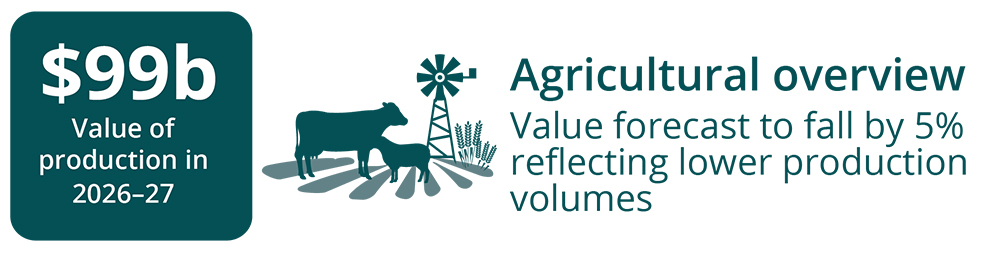
- Gross value of agricultural production to fall by 5% to $99.4 billion in 2026–27.
- 2026-27 production to be supported by wetter than expected winter in southern Australia.
- Agricultural export value to fall by 5% to $76.3 billion driven by lower livestock and crop production.
- Average broadacre farm business profit to fall by 39% driven by falling revenue and continued high costs.
- H5 high pathogenicity avian influenza (H5 bird flu) has been detected in wildlife in Australia.
- Australia remains free from H5 bird flu in poultry production.
Download this report: Overview (PDF - 1.9 MB)

- Average to above average winter rainfall has boosted soil moisture levels across most south-eastern growing regions, providing an improved outlook for 2026–27 winter crop yield potential.
- Crops in many regions are more advanced than usual for this time of year, and combined with high soil moisture levels in the southeast, will reduce reliance on spring rainfall for finishing winter crops
- In contrast, winter-to-date rainfall totals in northern New South Wales and Queensland, have only been sufficient to support a delayed establishment and below average yield expectations for 2026–27 winter crops, with minimal improvements in stored soil moisture levels.
- The current El Niño may lead to lower spring rainfall for parts of Australia, but impacts are highly uncertain.
- A slight reduction in global production outcomes are anticipated due to some dryness and excessive heat observed across some major grain and oilseed producing regions.
Download this report: Seasonal conditions (PDF - 1.9 MB)
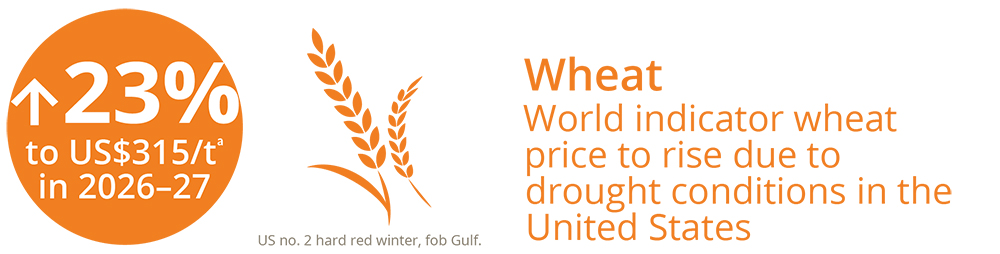
- Gross value of wheat production to fall by 14% to $9.9 billion in 2026–27, driven by falling production.
- Value and volume of wheat exports to fall in 2026–27.
- Australian wheat production to remain above historical averages reflecting favourable growing conditions in South Australia and Victoria.
- Wheat production to fall across most major exporters, placing upward pressure on prices.
Download this report: Outlook for wheat (PDF - 1.9 MB)
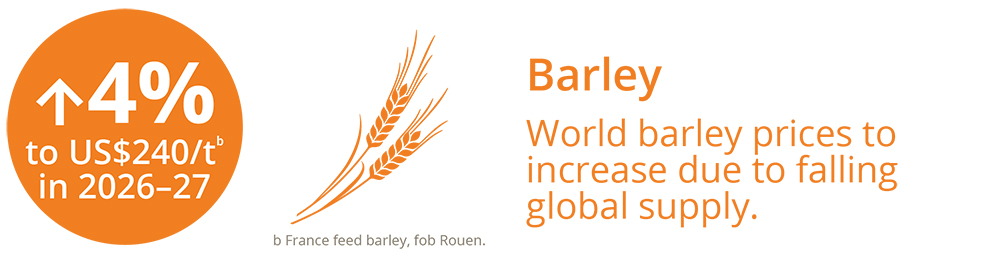
- Gross value of barley production to rise to $5.1 billion in 2026–27 with higher prices and strong production.
- Australian barley production is forecast to be the second highest on record.
- Gross value of sorghum production to decrease by 22% to $738 million reflecting lower production.
- Rising prices reflect a forecast fall in global coarse grain exportable supply in 2026–27.
- Coarse grain export volume and value to decrease in 2026–27, however, remain above long–term averages.
Download this report: Outlook for coarse grains (PDF - 1.9 MB)

- Value of canola production to fall by 5% to $5.5 billion in 2026–27, driven by lower production.
- Value and volume of canola exports to rise in 2026–27, despite lower production.
- Freight disruption to impact Australia’s export competitiveness.
- Global demand for oilseeds to remain robust in 2026–27, supporting prices.
Download this report: Oilseeds - PDF
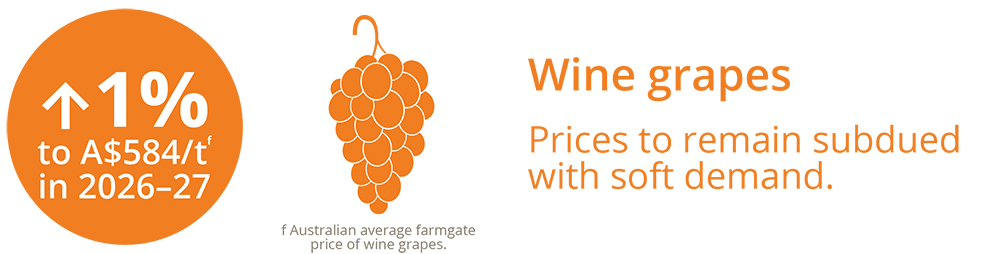
- Value of Australian wine grape production to fall by 4% to $700 million in 2026–27.
- Value of Australian wine exports to fall by 12% to $2.1 billion in 2026–27.
- Average wine grape prices expected to remain below long-term average levels in 2026–27.
- Wine grape production for crush to fall by 5% to 1.2 million tonnes in 2026–27.
Download this report: Wine - PDF
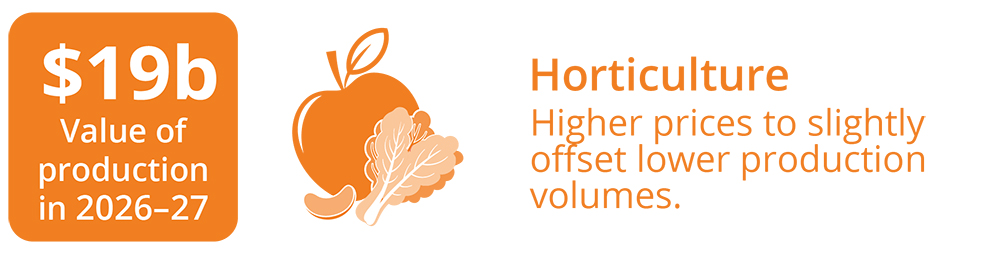
- Value of horticulture production to reach a record high of $18.8 billion in 2026–27.
- Value of horticulture exports to increase by 3% to $4.4 billion in 2026–27.
- Horticulture export prices to rise in 2026–27, reflecting robust global demand.
- World supply of fruits and nuts to increase as growing conditions improve in major producing countries.
Download this report: Horticulture - PDF
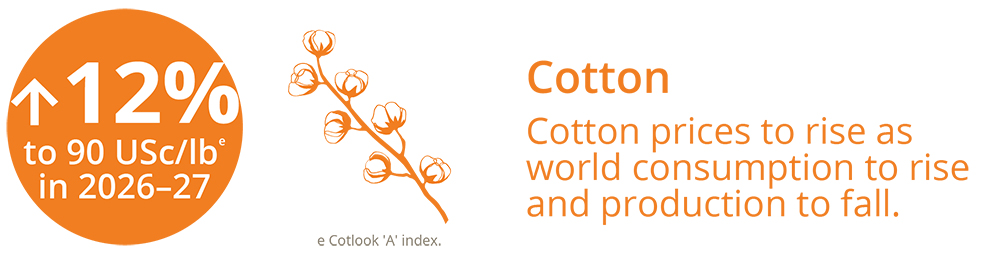
- The gross value of cotton production to fall by 29% to $1.8 billion in 2026–27.
- Cotlook A Index to rise by 12% to average 90 US cents per pound in 2026–27.
- Cotton production to fall by 34% in 2026–27 due to reduced area planted to cotton.
- The value of cotton exports to decline by 13% to $2.9 billion in 2026–27.
Download this report: Cotton - PDF
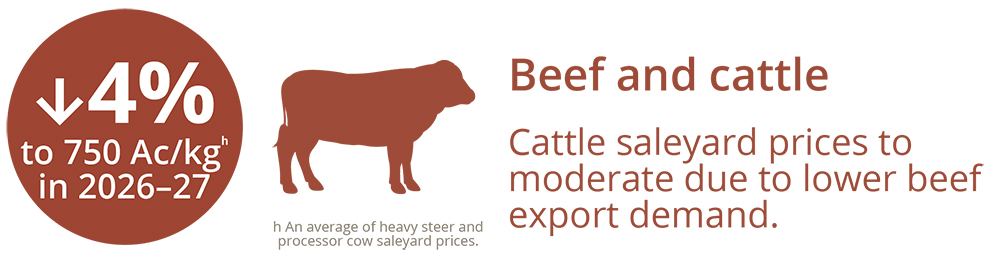
- The gross value of cattle slaughter and live exports to fall by 9% to $22.4 billion in 2026–27.
- ABARES indicator price for finished cattle to average 4% lower in 2026–27.
- Beef production to moderate by 5% in 2026–27 to 2.9 million tonnes but be second highest on record.
- The value of beef and live cattle exports to fall by 14% to $18.6 billion in 2026–27.
- Lower global beef supply and to support Australian exports despite reduced market access.
Download this report: Beef and cattle - PDF
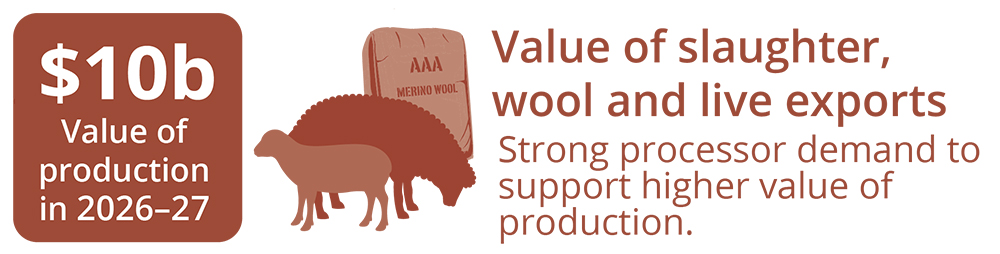
- Gross value of sheep slaughtering, wool and live sheep for export to rise 2% to $10.3 billion in 2026–27.
- Saleyard prices to moderate as softening sheep meat export prices reduce processor competition.
- Value of sheep meat, wool and live sheep exports to rise by 2% to $9.4 billion.
- Sheep meat production level steady as increased lamb slaughter shields against fall in mutton slaughter.
- Eastern Market Indicator to rise by 15% to 1,840 cents per kilogram in 2026–27.
Download this report: Lamb, sheep and wool - PDF
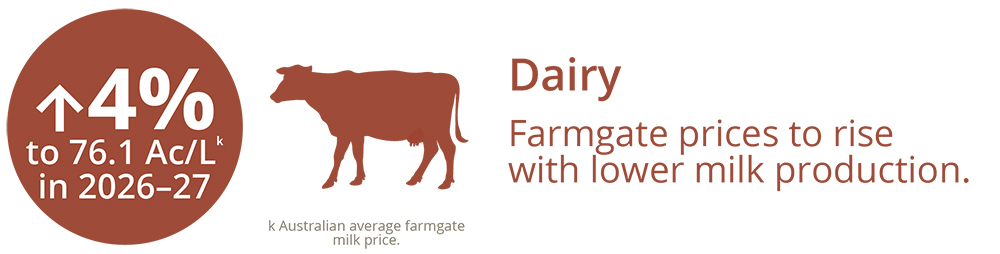
- Gross value of milk production to rise by 2% in 2026–27 driven by a higher farmgate milk price.
- Volume of milk production to fall by 1% due to declines in the milking herd.
- Value and volume of dairy exports to fall, driven by lower domestic milk production.
- Dairy product export prices to fall given strong global supply and weaker global demand growth.
Download this report: Dairy - PDF
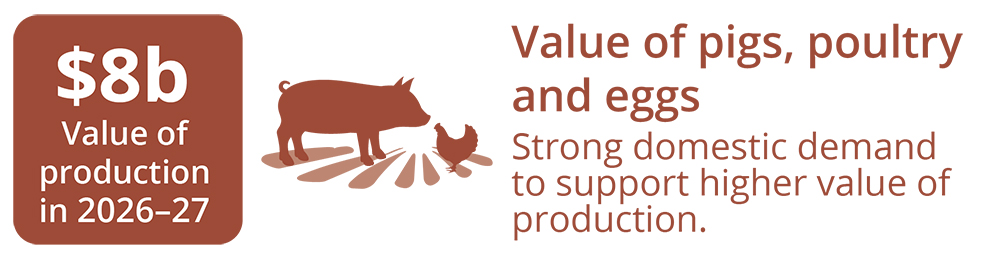
- Value of pig slaughtering to fall by 6% to $2.0 billion in 2026–27.
- Value of poultry slaughtering to increase by 6% to $4.4 billion in 2026–27.
- Value of egg production to remain steady at $1.4 billion in 2026–27.
- H5 high pathogenicity avian influenza (H5 bird flu) has been detected in wildlife in Australia.
- Australia remains free from H5 bird flu in poultry production.
Download this report: Pigs, Poultry, Eggs - PDF