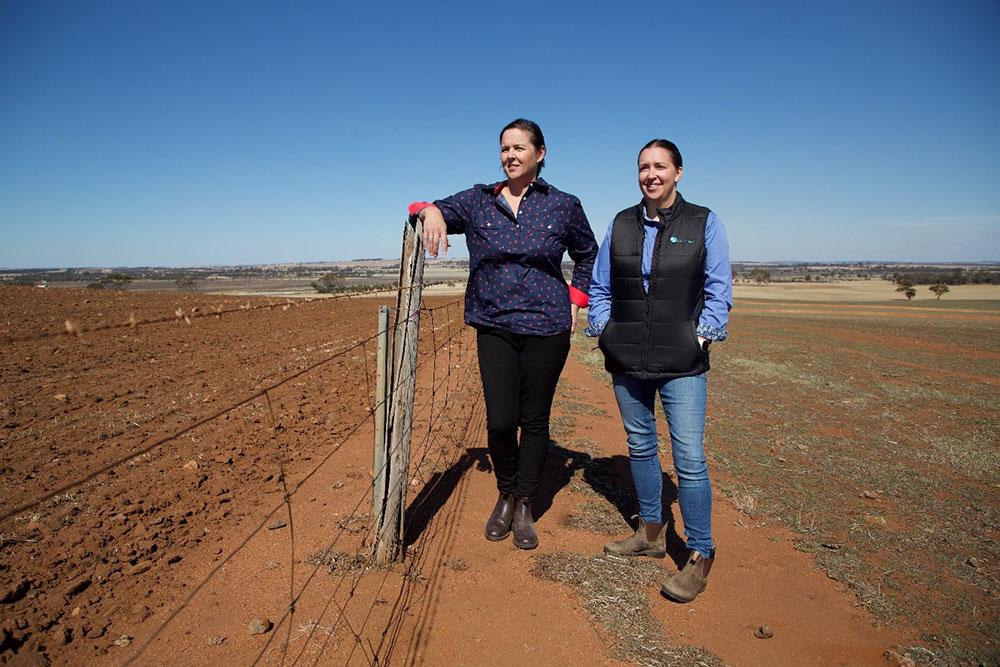

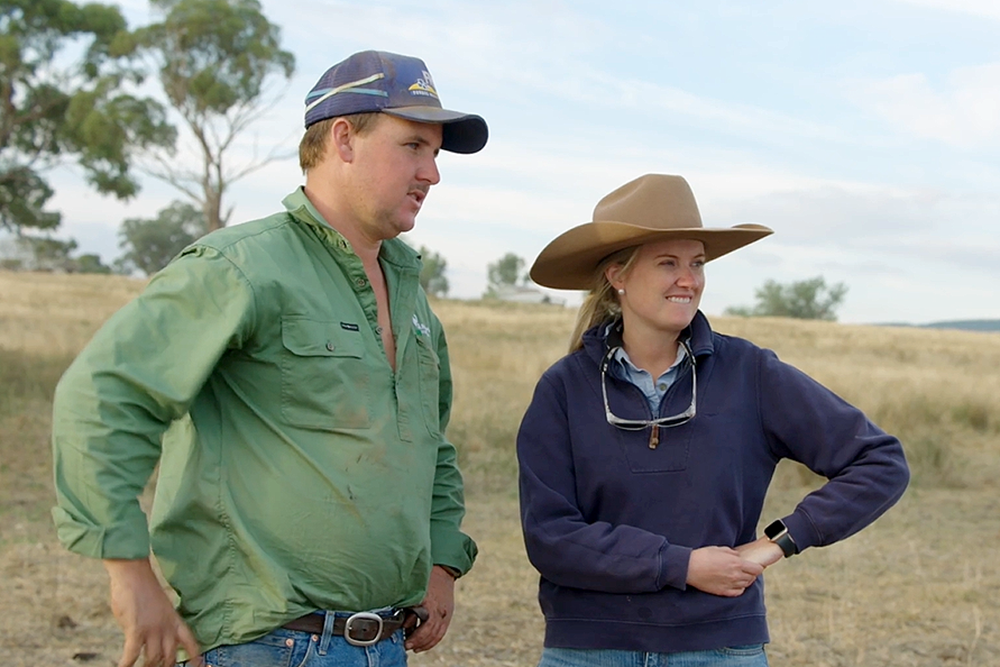
Caitlin Herbert and Michael Taylor are 2024 Future Drought Fund (FDF) Nuffield Drought Resilience Scholars who share a common goal: building resilience and sustainability in Australian agriculture.
Both are sixth-generation farmers from New South Wales operating in regions highly exposed to climate variability who have embraced innovation and diversification to mitigate the impacts of drought. Through their research, supported by the FDF, they are exploring strategies to strengthen business resilience, improve resource management and ensure long-term viability for farming enterprises.
For Caitlin, drought resilience is about maintaining consistent production in the face of seasonal uncertainty. Based in Eugowra, Central West NSW, she helps runs Gundamain, her family’s 15 000-acre property, comprised of a cattle feedlot, a sheep operation for wool and prime lambs and a dryland cropping enterprise. Integrating an Angus breeding herd with a managed feedlot system allows Caitlin to control nutrition and deliver a consistent product year-round for domestic and export markets.
Her approach includes detailed drought plans, strategic destocking and stockpiling enough hay and silage to feed livestock for up to two years. Caitlin’s FDF Nuffield drought resilience scholarship focuses on best-practice intensification of the beef industry, particularly how to destock without compromising genetics or animal condition.
“No matter what type of agricultural production we run, no one is immune from drought. Having this brains trust to engage and share ideas has been invaluable”, says Caitlin, of the 2024 Nuffield Scholar cohort she now regularly checks in with.
One of that same cohort is Michael Taylor. His FDF Nuffield drought resilience scholarship focus is on integrating agroforestry into grazing systems to improve resilience and sustainability. Based on the New England Tablelands in Northern NSW, Taylors Run combines grazing with agroforestry and agritourism.
Trees provide shade and shelter for livestock, improving survival rates during extreme heat and lambing periods, while also contributing to long-term ecosystem health. Diversification into tourism helps offset commodity market fluctuations which reduces financial risk during dry times.
Michael hopes his research will identify and help producers overcome barriers to agroforestry adoption in grazing and cropping regions. “There’s plenty of research on the benefits, but not much on overcoming the practical challenges,” he explains. His short-term goal is to inform industry leaders and policymakers, which he hopes will see him achieve his longer-term goal of improving resilience and sustainability across his region, and across Australian farming more broadly.
Together, and with supported research into best practice and innovation in their industries, Caitlin and Michael exemplify how proactive planning, diversification, and knowledge-sharing can help Australian farmers adapt to an increasingly variable climate.
Stay updated on Nuffield Scholar opportunities and projects at www.nuffield.com.au
Watch the case study videos to see how 2024 FDF Drought Resilience Scholars Caitlin Herbert and Michael Taylor are driving drought resilience through innovation and collaboration.
Video duration: 4 mins 11 secs
[Recording begins]
Video begins [0:00]
Music plays.
Caitlin Herbert [00:16]
My name is Caitlin Herbert. I'm sixth generation farming here at Gundamain in Central West New South Wales. We're based in Eugowra over about 15,000 acres and we farm a cattle feedlot, a sheep operation, including merinos for wool and prime lambs, and a dry land cropping operation.
Integrating into the feedlot, we have an Angus breeding herd where we produce our own calves and feed them all the way through. I think the best way to describe a cattle feedlot is it's a managed facility where the cattle are fed a nutritious diet every day that's formulated by a nutritionist. The reason we have a cattle feed lot is we can turn off a consistent product so we can turn off animals 12 months of the year and we control what they're eating. It ensures that we fill a market, both domestic and export for 12 months of the year no matter what dry conditions hit us or seasonality hits us.
Drought is really quite high on our risk registry, so we have plans in place and we know when to implement these plans as we're going into a drought; including destocking, where to destock first, what paddocks to sacrifice, what to start feeding out first, including hay and silage and where best to allocate these resources.
We grow a lot of lucerne now and we always have every hay shed full on the property and we always ensure the silage pits are full. This has allowed us to stockpile enough feed for 18 to 24 months in case a drought were to hit us.
Australia's climate variability was a large catalyst in the formation of the Australian feedlot industry, and it continues to define the definition of what we do today, why we can keep feeding cattle during dry times drought conditions historically force an intensification of the extensive beef industry in Australia and feedlots provide a place where we can put these cattle and still maintain consistent product over dry conditions.
Being a 2024 Nuffield scholar funded by FDF has allowed me to take time away from our business and explore businesses and operations similar to ours on an international scale. I've then been able to bring these practices back to our business and implement innovations and technologies that are happening outside of Australia and bring that knowledge not just back to Gundamain, but back to the wider agricultural community.
As part of my Nuffield research, I'm looking into best practice intensification of the extensive beef industry. For me, this is centred around food security and how to best destock without compromising good genetics or the condition of the cattle that you're selling. One of the best things about being a Nuffield scholar is I've been able to connect with other people who, despite the diversity of our operations, we're going through the same joys and struggles in our day-to-day operations.
Particularly in reference to drought, it's shown me that no matter what type of agricultural production we run, no one is immune from drought and we both share the same highs and lows and you have this brain's trust to engage and converse with and share your story.
Farming and working in agriculture really leaves you…you're at the mercy of the climate. And I think being resilient is just mitigating any type of risk that may come your way while still maintaining a successful and profitable business. I hope my learnings as a drought resilience scholar can strengthen the Australian beef supply chain and we can continue to remain a major player in the global beef industry.
Video voiceover ends [3:53]
Recording ends [4:11]
A screen displays the logos for the Department of Agriculture, Fisheries and Forestry and the Future
Video duration: 4 mins 58 secs
[Recording begins]
Video begins [0:00]
Music plays.
Michael Taylor [0:23]
I am Michael Taylor, sixth generation farmer. Taylors run is on the New England Tablelands, Northern New South Wales and we’re a grazing property, but we also have agroforestry and some agritourism. In simple terms, agroforestry is basically just woody vegetation, trees in particular, integrated with agriculture. So, agroforestry can be, all native trees, that were you know already growing there and the way you manage them, whether it's for shade and shelter or for a product, or it could be planted trees, special planted trees, or forestry type planted trees, t can also be fruit trees. So, there's a lot of orchards that would consider what they're doing as agroforestry as well but it's, it's integrating, woody vegetation into agricultural enterprise.
Australia does have a very dry environment. We don't have rich soils, but we've proven how productive we can be, but it's important that we're also going to be sustainable. So better understanding what aspects are going to continue to sustain our natural assets is really, really, important. Understanding that woody vegetation in an agroforestry type culture is really important part of maintaining and sustaining our agricultural enterprises for food security and economic stability across the regions.
For me, being drought resilient on Taylor's run is basically taking away that boom and bust cycle that a lot of farms see when various commodity markets come and go. We've got now, you know, alternative products that we can turn to when sheep prices are down, for example we've got the alternative enterprise of tourism. Being able to, to shift slightly to offset those extremely high, extremely low times is what I would consider being resilient, because it's, when it's extremely dry, that's when you are, you know, most at risk of the business collapsing or the ecosystem collapsing.
I would say one of the challenges in agroforestry is that it's a long-term enterprise, it's a long-term integration. Trees you accept that they grow slowly, you accept that they grow big and you accept that they drop branches and where there's live trees, there's going to be dead branches or dead trees.
So, the benefits of agroforestry on Taylor's run have obviously grown over time, excuse the pun, but having that extra shade and shelter for our animals has been quite distinct during the extreme times, during normal, you know, average days, it's not so obvious, but on the extremely hot days in summer, you can see the livestock making use of that shade and also survival of lambs or ewes during lambing coming out the end of winter or freshly shorn sheep off shears, we definitely have seen improvements in the survival rates of our sheep.
I applied for Nuffield Drought Resilience Scholarship because it would connect me with farmers not only across Australia, but farmers all around the world that are facing similar challenges to what we are here, locally and nationally. There is plenty of research around the benefits of agroforestry and what can be achieved but there's not a whole lot of research bringing those barriers together, especially in grazing and cropping areas that are not traditional forestry areas.
I'm hoping that my research, that's being supported by the Future Drought Fund, will help decision makers and leaders across the agricultural industry understand and make changes that will bring down some of the barriers to agroforestry, which will improve resilience and sustainability.
Video voiceover ends [4:41]
Recording ends [4:58]
A screen displays the logos for the Department of Agriculture, Fisheries and Forestry and the Future Drought Fund.
This project received funding from the Australian Government’s Future Drought Fund (FDF) via the FDF Drought Resilience Scholarship Program, delivered by Nuffield Australia.
Acknowledgement of Country
We acknowledge the continuous connection of First Nations Traditional Owners and Custodians to the lands, seas and waters of Australia. We recognise their care for and cultivation of Country. We pay respect to Elders past and present, and recognise their knowledge and contribution to the productivity, innovation and sustainability of Australia’s agriculture, fisheries and forestry industries.
© Commonwealth of Australia 2023
Unless otherwise noted, copyright (and any other intellectual property rights) in this publication is owned by the Commonwealth of Australia (referred to as the Commonwealth).
All material in this publication is licensed under a Creative Commons Attribution 4.0 International Licence except content supplied by third parties, logos and the Commonwealth Coat of Arms.
The Australian Government acting through the Department of Agriculture, Fisheries and Forestry has exercised due care and skill in preparing and compiling the information and data in this publication. Notwithstanding, the Department of Agriculture, Fisheries and Forestry, its employees and advisers disclaim all liability, including liability for negligence and for any loss, damage, injury, expense or cost incurred by any person as a result of accessing, using or relying on any of the information or data in this publication to the maximum extent permitted by law.