
Skip to main content Skip to main navigation Skip to search
ABARES

Top navigation abares

  • Department
  • Ministers
  • Media Centre
Main menu

Main navigation ABARES

  • ABARES Home
    ABARES Home
  • About
    About
  • Research topics
    Research topics
  • Products
    Products
  • Data
    Data
  • News
    News
  • Conferences and events
    Conferences and events
  • Careers
    Careers
Department of Agriculture

Breadcrumb

  1. DAFF Home
  2. ABARES
  3. Research topics
  4. Social sciences
  5. Creating win-wins in grains biosecurity with agronomists (WinGrains)

Secondary ABARES

  • Social sciences
    • Creating win wins in grains biosecurity with agronomists
    • Australian marine pest network analysis
    • Biosecurity research
    • Climate research
    • Community engagement
    • Community involvement in plant biosecurity
    • Human dimensions research
    • Making general surveillance work
      • General surveillance case study overviews
      • Guidelines for general surveillance programs
      • Literature review: Understanding general surveillance as a system
      • Research report: Making general surveillance programs work
      • Stocktake of general surveillance initiatives
    • Natural resource management
    • Pest animal and weed management survey
    • Recreational boat operators’ self-management of biofouling in Australia
    • Social aspects of weed management
    • Social impact assessment
    • General surveillance program design, monitoring and evaluation manual

Creating win-wins in grains biosecurity with agronomists (WinGrains)

Pests, weeds and diseases are placing increasing pressure on grain production. Addressing these challenges will require new and more effective ways to prevent, prepare for, manage and respond.

There are opportunities to work smarter, not just harder. To do this well, we need practical input from people across the system.

Agronomists play a key role. They work directly with growers through trust-based relationships, are present in paddocks and often see issues as they emerge. However, their experiences and insights have not been well explored in past research.

This project aims to identify practical, ‘win–win’ approaches that deliver value for agronomists, growers and the broader system.

Get involved

We are inviting people from across industry, governments and research to provide input to this study. Your experience can help shape approaches that are practical, useful and grounded in real-world conditions. 

There are three ways to get involved and you are welcome to contribute in more than one way.

Who can take part

Anyone with an interest in the role of agronomists in grain crop protection, including:

  • agronomists (independent and retail)
  • growers
  • researchers
  • industry representatives
  • government staff (policy, response, market access, diagnostic and identification, etc.).

What’s involved

  • A discussion with one or two members of the research team (~ 60 minutes).
  • Share your views on what currently works and what doesn’t.
  • Discuss how agronomists and others are supported.
  • Explore a small number of practical scenarios and value propositions for agronomists.
  • Suggest ideas for improving outcomes across the system.

What you’ll gain

  • Have your voice heard and inform future programs and investments.
  • Reflect on current challenges and opportunities in your work.
  • Contribute to ideas that aim to deliver real, practical value.
  • Receive a summary of overall findings from the project.

Privacy

All responses are confidential. Information will be de-identified in reporting.

Register your interest

If you would like to take part in an interview, or would like more information, please get in touch by contacting Laura Butler, the Project Officer, on socialsciences.abares@aff.gov.au.

What the workshops cover

These workshops build on insights from interviews and explore a set of potential ‘win–win’ initiatives.

Participants will likely include:

  • agronomists (retail and independent)
  • growers
  • researchers 
  • industry organisations 
  • government staff (including those in plant health, communication, policy roles and others).

What’s involved

  • Review and discuss proposed initiatives to better involve agronomists in crop protection.
  • Test how practical and useful these proposed initiatives are.
  • Help refine ideas so they work in real-world settings.

Why your input matters

Input from people across the system is important to ensure initiatives:

  • are practical to implement
  • deliver clear value
  • fit within existing workloads and systems.

What you’ll gain

  • Influence how future initiatives are designed.
  • Learn how others are approaching similar challenges.
  • Connect with people across regions and roles.
  • Contribute to approaches that may reduce effort and improve outcomes over time.

Workshop details

  • 2-hour online sessions.
  • Held separately for WA, SA, NSW and QLD during August and early September.

Why participate?

By taking part, you will help to:

  • shape practical solutions grounded in on-the-ground experience
  • ensure the perspectives of your role are well represented
  • identify approaches that improve outcomes while minimising burden
  • inform future programs, policies and investments in crop protection.

Register your interest

If you would like to take part in a workshop, or would like more information, please get in touch by contacting Laura Butler, the Project Officer, on socialsciences.abares@aff.gov.au.

Who this is for

Agronomists working in grain crop protection (independent or retail).

What’s involved

  • A short online survey (10–15 minutes).
  • Share your views on a range of potential scenarios and value propositions.
  • Indicate which approaches you see as most useful or relevant in practice.

What you’ll gain

  • A quick and easy way to contribute your perspective.
  • Input into shaping practical initiatives that reflect the realities of your work.
  • An opportunity to highlight what would provide genuine value to agronomists.

Timing

The survey will be available from 10 August. A link will be published on this page.

Register your interest

You can register for the survey by emailing Laura Butler at socialsciences.abares@aff.gov.au and we will email you the link when it is available.

Your experience matters

Even small insights can make a difference. By sharing your perspective, you are contributing to practical solutions that aim to support the grains industry now and into the future.

About the project

ABARES Social Sciences Program is leading this research which is funded by the National Grains Diagnostic and Surveillance Initiative (NGDSI).

The NGDSI is a partnership between the Grains Research and Development Corporation (GRDC) and departments responsible for agriculture across the Australian Government and various state governments.

The research is supported by a reference group of industry and government representatives.

Project stages

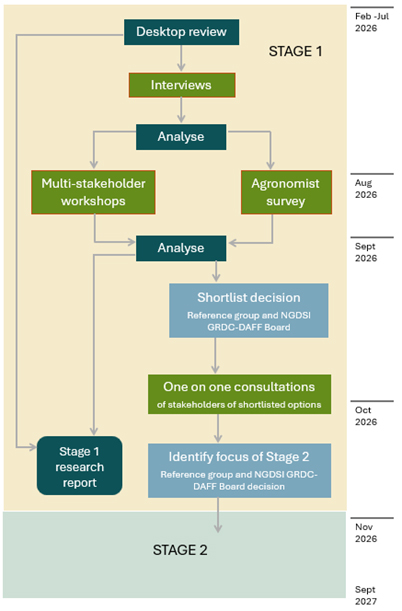
  • Stage 1 (until October 2026): Interviews, a survey, and workshops with agronomists and other key stakeholders to identify opportunities for collaboration. It focuses on the grain growing regions in the west, south and north.
  • Stage 2 (November 2026 - September 2027): The outcomes of Stage 1 will inform the next steps of the project, which may include a pilot program codesigned with agronomists.

The project is due for completion by September 2027.
Decorative

Figure 1: Overview of the project steps

Red framed boxes indicate opportunities for participation

Stay updated

This page will be updated regularly as the project progresses. For more information, contact Laura Butler, the Project Officer, on socialsciences.abares@aff.gov.au.

Thanks for your feedback.
Thanks! Your feedback has been submitted.

We aren't able to respond to your individual comments or questions.
To contact us directly phone us or submit an online inquiry

CAPTCHA
This question is for testing whether or not you are a human visitor and to prevent automated spam submissions.

Please verify that you are not a robot.

Skip
Page last updated: 02 July 2026

We acknowledge the continuous connection of First Nations Traditional Owners and Custodians to the lands, seas and waters of Australia. We recognise their care for and cultivation of Country. We pay respect to Elders past and present, and recognise their knowledge and contribution to the productivity, innovation and sustainability of Australia’s agriculture, fisheries and forestry industries.

Artwork: Protecting our Country, Growing our Future
© Amy Allerton, contemporary Aboriginal Artist of the Gumbaynggirr, Bundjalung and Gamilaroi nations.

Footer

  • Contact us
  • Accessibility
  • Disclaimer
  • Privacy
  • FOI

© Department of Agriculture, Fisheries and Forestry

Facebook X LinkedIn Instagram