Dr Richard Willan
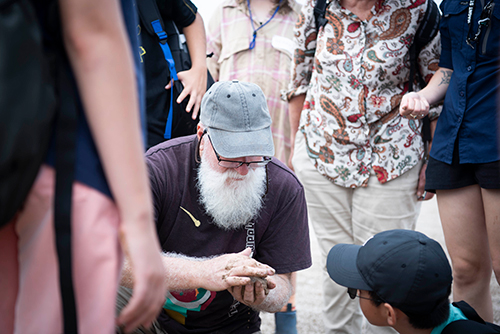
Dr Richard Willan is a renowned marine invertebrate taxonomist who has studied and delighted in molluscs for over 50 years. He has held positions at the University of Auckland and University of Queensland. He is Curator Emeritus of Molluscs at the Museum and Art Gallery of the Northern Territory. His expertise in identifying marine and freshwater pests and deep knowledge of aquatic invertebrate taxonomy and biology have significantly strengthened national pest management efforts.
With a passion for community biosecurity management, Dr Willan actively engages with community groups to build awareness and capacity in aquatic biosecurity – ensuring that scientific knowledge translates into practical, on-the-ground impact. He is a tireless contributor to community-led biosecurity efforts, consistently volunteering his knowledge and time to support environmental education, conservation efforts and community engagement initiatives. His dedication has been recognised through numerous community accolades, including life membership of the Auckland University Underwater Club, Conchology Section of Auckland War Memorial Museum (Auckland Shell Club), the Malacological Society of Australasia and the Northern Territory Field Naturalists’ Club. Dr Willan is also involved in citizen science community organisations, particularly iNaturalist, QuestaGame and Reef Life Survey.
Dr Willan began his career in mollusc research in New Zealand, but he has since become a cornerstone of Australia’s biosecurity system. For over 30 years, he has provided expert taxonomic identification of marine and freshwater invertebrates and played a pivotal role in biosecurity responses. Not all introduced species pose a threat, so his ability to rapidly confirm detections has enabled timely action in cases where intervention was critical. Most notably in 1999, when his swift identification of the black-striped false mussel (Mytilopsis sallei) led to one of the world’s few successful eradications of an established, highly invasive marine pest.
Dr Willan has also provided invaluable technical support to the Indigenous Ranger Biosecurity Program. His expert identifications enhance the program’s effectiveness in protecting northern Australia’s aquatic environment from exotic invasive species and fostering meaningful collaborations with First Nations communities.
He played a key role in assessing species for the development of the initial Australian Priority Marine Pest List – a national awareness tool that supports marine pest surveillance. He also contributed to the implementation of MarinePestPlan 2018–2023, Australia’s national strategic plan for marine pest biosecurity.
As a technical expert, he supports jurisdictions and the national Consultative Committee on Introduced Marine Pest Emergencies by providing subject matter expertise on the biology, ecology, impacts and control of marine and freshwater pests.
In addition to his advisory roles, Dr Willan has trained government biosecurity personnel in the identification of marine and freshwater pests and continues to provide ongoing informal training in identification of local and exotic species. His mentorship helps build national capability in early detection and response to aquatic biosecurity threats.
Dr Willan’s legacy extends beyond scientific excellence to meaningful community impact. Through his decades-long commitment to aquatic biosecurity, he has not only safeguarded Australia’s marine ecosystems, but also enabled local communities, government agencies and industry stakeholders with timely, expert guidance. His collaborative approach and dedication have fostered trust and strengthened national pest management networks, ensuring that biosecurity responses are informed, swift and inclusive. Dr Willan exemplifies how scientific expertise can be a powerful force for community resilience and environmental stewardship.
Watch a video about their work
Introduction
This is the accessible text transcript of the 2025 Australian Biosecurity Awards winner video featuring Dr Richard Willan.
Transcript
Hello everyone.
I’m Richard Willan and I’m speaking to you this morning from the Casuarina Coastal Reserve in Darwin.
I want to thank the Department of Agriculture, Fisheries and Forestry for the Biosecurity Award.
This award for me is an interesting one because the critters that I study, molluscs, can’t be seen.
That’s because they live in the sea and under bodies of freshwater.
Although they can’t be seen, their consequences can be enormous, for the environment and for infrastructure such as that of the black-striped mussel which invaded Darwin in 1999 and was successfully eradicated.
On the other hand, their interactions with communities can be imperceptible, like nudibranchs.
Talking of communities, and this award is in the Community category, I have been involved with many communities throughout my long life’s journey, from clubs and societies to virtual communities of today.
And the important thing to remember is that although I give the advice to the communities, we must listen back to their voice.
Throughout my life, I’ve been supported enormously in all my stages by my family, and I thank them very much.
Photos