
Skip to main content Skip to main navigation Skip to search
Home

Top navigation main

  • News & media
  • Jobs
  • Ministers
  • Contact us
Main menu

AWE Main

  • Agriculture and land
    Agriculture and land Building stronger and more sustainable agriculture, fisheries, forestry and land care.
    • Animal health
    • Climate change and agriculture
    • Farming, food and rural support
    • Fisheries
    • Forestry
    • Levies and charges on agricultural products
    • Mouse infestation advice
    • Plant health
    Farmer in a wheat field at sunset

    Drought, disaster and rural support

    Farmers and rural communities face many risks to their business.

    Find out more

  • Biosecurity and trade
    Biosecurity and trade
    • Aircraft, vessels and military
    • Biosecurity policy
    • Cats and dogs
    • Exporting
    • Importing
    • Pests, diseases and weeds
    • Public awareness and education
    • Trade and market access
    • Travelling or sending goods to Australia
    • Report a concern
    Brown marmorated stink bug

    BMSB Seasonal Measures

    Australia has strengthened seasonal measures to manage the risk of BMSB.

    View our seasonal measures

  • Science and research
    Science and research Undertaking research and collecting data to support informed decisions and policies.
    • Australian Bureau of Agricultural and Resource Economics and Sciences (ABARES)
    • Plant Innovation Centre
    Abares

    ABARES Insights

    Get 'snapshots’ of agricultural, forestry and fisheries industries, or analysis of key issues.

    Find out more

  • About us
    About us We enhance our agricultural industries and trade, and manage the threat of biosecurity risks to Australia.
    • Accountability and reporting
    • Assistance, grants and tenders
    • Contact us
    • Fees and charges
    • News and media
    • Our commitment to you
    • Payments
    • People and jobs
    • Publications
    • What we do
    • Who we are
    Budget 2026-27

    Budget 2026-27

    The 2026–27 Portfolio Budget Statements were released on 12 May 2026.

    Find out more

  • Online services
    Online services We do business with you using online platforms. This makes it easier for you to meet your legal requirements.
Department of Agriculture

Breadcrumb

  1. Home
  2. About us
  3. News and media
  4. What’s bugging you?

Back to news - AWE

  • Back to news

What’s bugging you?

  • News
  • Biosecurity
17 August 2026
Senior Entomologist Mike Elias
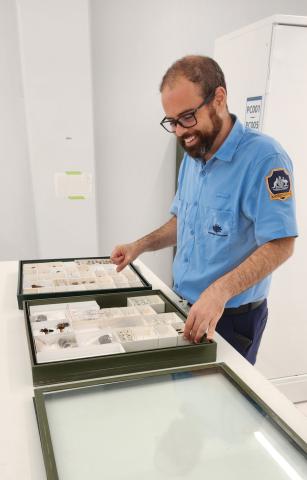
Mike reviewing insects in the specimen vault of the new insect collection at CSIRO.

From a young age, Department of Agriculture, Fisheries and Forestry (DAFF) Senior Entomologist Mike Elias loved insects. He was the kid who would collect bugs and bring them home, and he never grew out of it. Today, that lifelong fascination supports the scientific work that helps protect Australia from exotic pests and diseases.

“I still like collecting insects; I find them fascinating,” said Mike, who now works at the new state-of-the-art Australian National Insect Collection (ANIC) facility based at the Commonwealth Scientific and Industrial Research Organisation (CSIRO) in Canberra.

There, he is surrounded by about 12 million insect specimens that help scientists at DAFF’s eight laboratories identify pests and stop their entry into Australia. The collection (largely owned by CSIRO) is an important part of Australia’s biosecurity system, helping scientists quickly and accurately identify insects that could pose a risk to our industries, environment and communities.

Mike’s primary role is to help DAFF scientists identify insects at the species level, by sharing specimens and providing advice. He also leans on the expertise of CSIRO entomologists and taxonomists.

While never intending to make insect identification his career, he has been working in diagnostic roles since completing his doctorate in new plant bugs.

Working for DAFF in Sydney and Canberra, he later moved to a state-based insect collection facility in Orange before moving to ANIC. Throughout his career, Mike has helped build Australia’s insect identification capability and scientific knowledge.

“We have one of the best biosecurity systems in the world, and what we do as DAFF scientists behind-the-scenes is of critical national importance,” he said.

“Being a functional entomologist is very complex work; at DAFF, you need about two years of training to be good at it.

“What I love is the variety. One day it might be species identification, another day it might be research or providing policy advice.”

Another plus for Mike is he has an insect named after him. It’s called Panaetius eliasi – a rare species of Australian shield bug he discovered in New South Wales.

“I found it in a swamp in Smiths Lake and gave it to my colleague, who named it after me,” he said.

For Mike, discoveries like these are a reminder that safeguarding Australia's unique species starts with a strong biosecurity system.

Behind every identification is a network of scientists, researchers and biosecurity professionals working to strengthen our biosecurity system, because Australia is worth protecting.

Learn how DAFF is helping build a stronger, more resilient system for the future: Biosecurity 2030 roadmap.

  • Share on Facebook
  • Share on Twitter
  • Share on LinkedIn
  • Email
  • Copy link

Related

Decorative image

H5 bird flu updates

  • Statement
  • Biosecurity
14 August 2026
decorative image

Western Sydney International Airport strengthens Australia’s trade and biosecurity future

  • News
  • Biosecurity
30 July 2026
Decorative

New arrival rules for boats and ships coming to Australia

  • News
  • Biosecurity
29 July 2026
Thanks for your feedback.
Thanks! Your feedback has been submitted.

We aren't able to respond to your individual comments or questions.
To contact us directly phone us or submit an online inquiry

CAPTCHA
This question is for testing whether or not you are a human visitor and to prevent automated spam submissions.

Please verify that you are not a robot.

Skip
Page last updated: 17 August 2026

We acknowledge the continuous connection of First Nations Traditional Owners and Custodians to the lands, seas and waters of Australia. We recognise their care for and cultivation of Country. We pay respect to Elders past and present, and recognise their knowledge and contribution to the productivity, innovation and sustainability of Australia’s agriculture, fisheries and forestry industries.

Artwork: Protecting our Country, Growing our Future
© Amy Allerton, contemporary Aboriginal Artist of the Gumbaynggirr, Bundjalung and Gamilaroi nations.

Footer

  • Contact us
  • Accessibility
  • Disclaimer
  • Privacy
  • FOI

© Department of Agriculture, Fisheries and Forestry

Facebook X LinkedIn Instagram