

News and Alerts
On 20 January 2027, Australia’s import conditions for nursery stock will be updated in accordance with the department’s final pest risk analysis for bacterial pathogens in the Xylella genus.
Offshore laboratories seeking to conduct testing of plants for Xylella can now apply for registration under the Xylella Laboratory Authorisation Program.
Current emergency measures for Xylella will remain in place until conditions are updated.
Check Biosecurity Import Conditions (BICON) for all import conditions applying to your goods.
Upcoming changes to import conditions for Xylella host nursery stock
On 30 June 2026, we completed a pest risk analysis (PRA) for bacterial pathogens in the genus Xylella.
The PRA recommended several changes to Australia’s existing emergency measures. These changes aim to improve assurance in managing the risk of Xylella entering Australia in imported nursery stock and ensure we maintain Australia’s appropriate level of protection (ALOP).
From 20 January 2027, we will start a phased transition from emergency measures to ongoing import conditions.
The changes will impact plant genera that can host Xylella, imported as nursery stock.
Note: Some plant species currently categorised as high-risk nursery stock are not affected by the changes because onshore Xylella testing requirements are already in place.
What is changing?
We will make the following key changes to import conditions:
- expand regulation to cover all species of Xylella (not just X. fastidiosa)
- strengthen offshore testing requirements for tissue cultured plants from high-risk countries/regions
- mother tissue culture testing to be replaced with mother plant testing prior to establishment of tissue culture lines
- testing must be conducted by laboratories authorised by Australia
- update plant sampling and PCR test protocols, including new Ct cut-off limits
- a copy of the laboratory test report to accompany the phytosanitary certificate
- revise additional declarations made by exporting National Plant Protection Organisations (NPPO) to support assurance in offshore processes
- remove hot water treatment and offshore NPPO approved arrangements for non-tissue cultured imports.
To see how the changes specifically affect your import pathway, go to Key changes to import pathways.
What will not be changing?
These changes will not affect:
- the plant genera that are subject to Xylella conditions
- the list of high-risk Xylella countries/regions as determined by Australia
- the need for mandatory Xylella testing, if testing is already required under Australia’s emergency measures
- all other conditions in BICON applicable to the goods.
Find out about regulated plant genera and high-risk countries/regions on the Measures for Xylella page.
Implementation program
We recognise that nursery stock sourcing and production pathways, particularly for tissue cultured plants, can be complex.
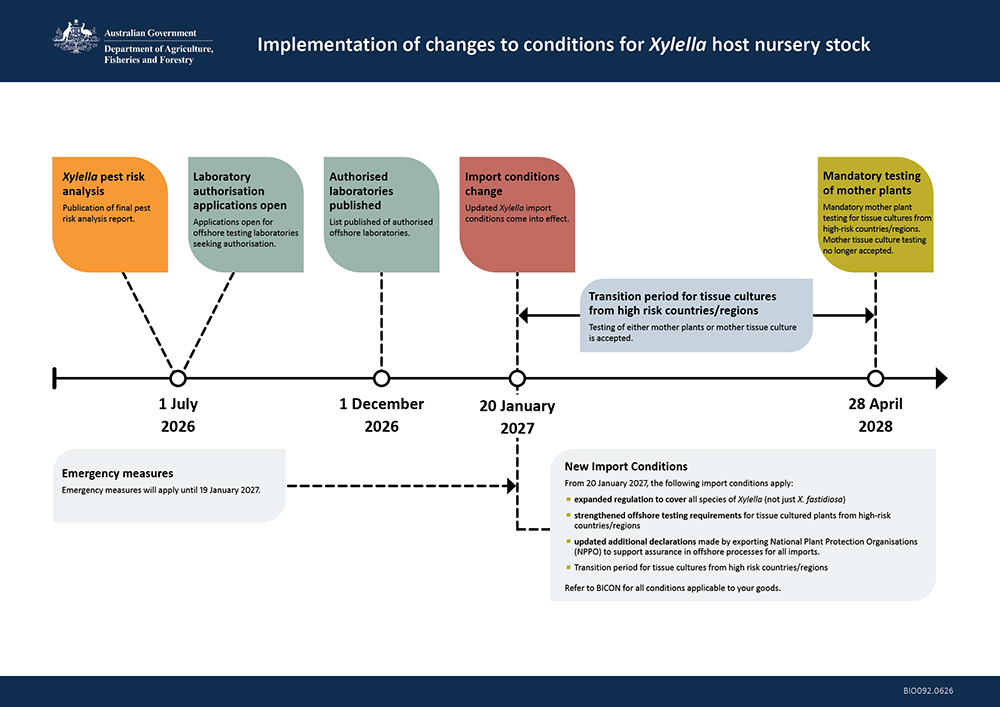
We will implement the updated conditions in stages (Figure 1). This will balance the need to introduce strengthened controls while enabling supply chains to adapt to the new requirements.
After the revised conditions are implemented, any consignments that do not comply with these new requirements may be subject to additional risk management measures. These could include export from Australia, disposal or post-entry quarantine and testing in Australia.
The following key dates apply:
| Date | Activity |
|---|---|
| From 30 June 2026 | Applications open for testing laboratories seeking to be authorised by Australia for Xylella testing.
|
| 20 January 2027 | Commencement of new import conditions. For tissue cultures from a high-risk country/region, a transition period from 20 January 2027 to 27 April 2028 will apply where we will accept testing of either mother tissue culture or mother plants. However, during this period all testing must comply with all other updated testing protocols and certification requirements. |
| 28 April 2028 | Conclusion of transition period for mother plant testing for tissue cultures exported from a high-risk country/region. Mandatory testing of mother plants will apply, and testing of mother tissue cultures will no longer be accepted. |
Figure 1. Implementation of upcoming changes to conditions for Xylella nursery stock.
Key changes for import pathways
From 20 January 2027, tissue cultures sourced from high-risk Xylella countries or regions must ensure that:
- exported plantlets are derived from either
- tested mother tissue culture – accepted only until 27 April 2028.
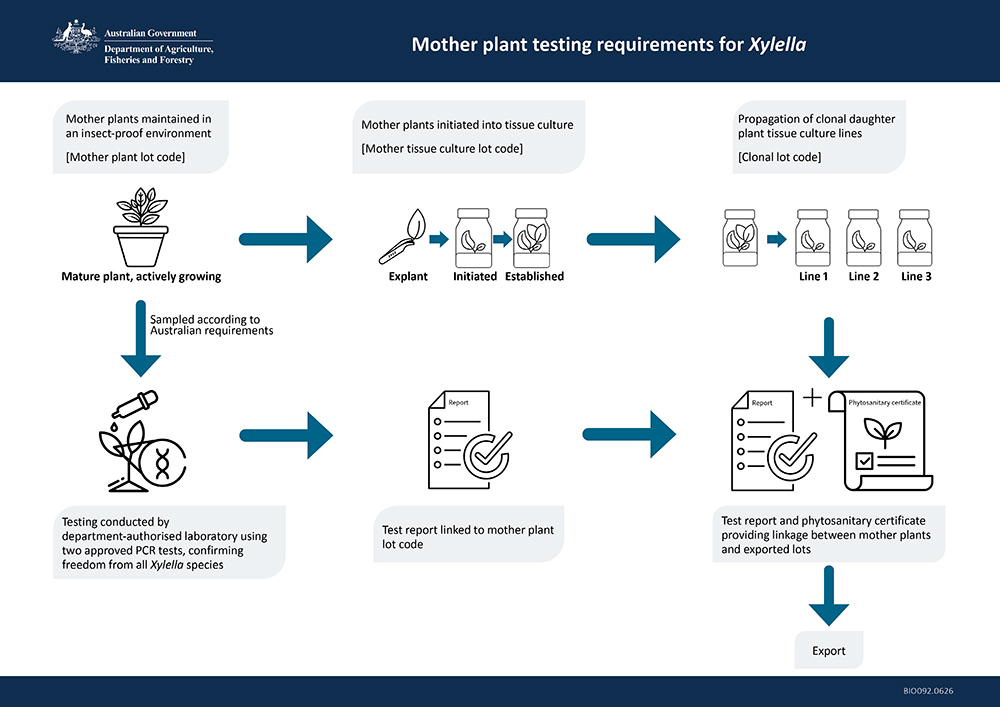
- tested mother plants (Figure 2).
- mother cultures/plants are sampled in line with updated sampling requirements and tested
- by a department-authorised laboratory
- using updated department-approved PCR protocols, with results interpreted using specific PCR cycle threshold (Ct) cut-off values.
- a copy of the laboratory test report(s) is provided to support clearance in Australia
- phytosanitary certificate(s) include updated additional declarations
- consignment documents demonstrate linkage between the tested mother plant (or during the transition period, mother tissue culture) and the export-ready tissue culture clonal plants.
Figure 2. Process for mother plant testing for Xylella
From 20 January 2027, updated additional declarations will be required in phytosanitary certificates to reflect the updated import conditions.
Phytosanitary certificate additional declarations must include:
Option 1 – Mother culture testing
Transitional arrangement for consignments certified before 28 April 2028
“The tissue cultures in this consignment comprise lot number/s [insert plant lot number(s)]; for each lot, plants were derived from mother tissue cultures that were sampled in accordance with ISPM 27 Annex 25 and Australia’s requirements. Samples were tested at [insert name of authorised laboratory] using two department-approved PCR tests and found free from any species of Xylella as indicated on laboratory report number [insert number/codes].”
Option 2 – Mother plant testing
“The tissue cultures in this consignment comprise lot number/s [insert plant lot number(s)]; for each lot, plants and their mother tissue cultures were derived from mother plants that were sampled in accordance with ISPM 27 Annex 25 and Australia’s requirements. Samples were tested at [insert name of authorised laboratory] using two department-approved PCR tests and found free from any species of Xylella as indicated on laboratory report number [insert number/code]. Mother plants were maintained in an insect proof environment while testing and cell collection was performed”
From 20 January 2027, non-tissue cultures must be grown in post-entry quarantine (PEQ) for at least 12 months at the Australian Government PEQ facility in Mickleham, Victoria. During this time, the plants will be tested to make sure they are free from Xylella. All PEQ and diagnostic services are subject to departmental fees and charges, at the importer’s expense.
From 20 January 2027, alternative options under emergency measures (e.g. hot water treatment or offshore NPPO-approved arrangements) will no longer be recognised as ongoing options to manage Xylella risk. Such measures will only be considered where a formal request is submitted, supported by a technical proposal, for departmental assessment.
From 20 January 2027, updated additional declarations will be required on phytosanitary certificates to ensure that exported tissue cultures and their mother plants were sourced from countries or regions that are recognised by Australia as being free from Xylella spp.
Phytosanitary certificate additional declarations must include:
Option 1 – Country of export is the same as the country of origin for the mother plants
"The tissue cultures in this consignment and the mother plants they were derived from, were grown only in [insert name of country], which is recognised by Australia as free from all species of Xylella."
Option 2 –Tissue culture and mother plants originate from different countries, both of which are free from Xylella spp.
"The tissue cultures in this consignment were grown in [insert name of country] and derive from mother plants grown only in [insert name of country]. Both countries are recognised by Australia as being free from all species of Xylella."
From 20 January 2027, updated additional declarations will be required in phytosanitary certificates to ensure that the plant material and their mother plants were sourced from countries or regions that are recognised by Australia as being free from Xylella spp.
Phytosanitary certificate additional declarations must include:
Option 1 – Country of export is the same as the country of origin for the mother plants,
"Plant material in this consignment and its mother plant/s were grown only in [insert name of country], which is recognised by Australia as being free from all species of Xylella."
Option 2 – Plant material and mother plants originate from different countries, both of which are free from Xylella spp.
"Plant material in this consignment was grown in [insert name of country] and derives from mother plants grown only in [insert name of country]. Both countries are recognised by Australia as being free from all species of Xylella."
Xylella testing requirements
From 20 January 2027, department-authorised laboratories must conduct Xylella testing in accordance with approved protocols set out by the department.
Laboratories must use 2 department-approved PCR protocols to verify the status of Xylella in plants:
- rimM gene sequence qPCR test from Harper et al. (2010, erratum 2013), and
- X-ComEC qPCR from Wong-Bajracharya et al. (2025, erratum 2025)
Note:
- No other tests are approved for verifying the status of Xylella in plant material. This includes the conventional PCR protocol from Minsavage et al. (1994) previously approved under the emergency measures, which will no longer be accepted from 20 January 2027.
- The department’s requirements (protocols application and result reporting) may differ from the parameters described in the referenced publications.
- If either approved test gives a positive result, it must be accepted. Positive results cannot be discounted on the basis of any other test result or consideration, except retesting following the ‘Retesting’ section.
Test results must be interpreted in accordance with the following PCR cycle threshold (Ct) values:
- For the Harper et al. (2010, erratum 2013) test: a result is positive if Ct ≤ 38.
- For the Wong-Bajracharya et al. (2025, erratum 2025) test: a result is positive if Ct ≤ 37.
If a laboratory considers that further information may be relevant to the interpretation of test results for a tested plant lot, it may contact the department for further advice.
To support confidence in testing results, samples collected for testing must be aligned with all the following requirements:
- protocols for asymptomatic plants provided in International Standard for Phytosanitary Measures (ISPM) no. 27 Annex 25: Diagnostic protocols for regulated pests DP25: Xylella fastidiosa (available from Adopted Standards (ISPMs) - International Plant Protection Convention), with sampling to be carried out late during the period of active growth of the plant. Sampling may be performed all year round for plants grown indoors exhibiting periods of active growth.
- a minimum of 4 representative samples from each plant, using stem and midrib material
- if mother plants are being tested, they must be maintained in an insect-proof environment during testing and tissue collection. This is to minimise the risk of infection via vectors before mother plants are initiated into tissue culture.
- If plant samples are pooled for testing, a maximum of 5 plants of the same species may be pooled under a single PCR test, where a sample is defined as a single piece of tissue.
- Samples from different plant species must not be pooled under a single PCR test.
Laboratory reports accompanying consignments must include the following information to support on-arrival clearance:
- the name and address of the department-authorised testing laboratory
- the full botanical name of the species tested
- the date of testing completion
- the plant lot number(s) tested
- the number of samples tested
- the pathogen targeted (i.e. Xylella spp.)
- the test primers and/or PCR protocols used
- the Ct cut-off points used to determine each test result
- the test result confirming freedom from Xylella spp. (e.g. ‘negative’ or ‘not detected’)
- a statement of compliance:
“Testing for Xylella spp. was conducted using primers and/or PCR protocols that were listed on the Australian Department of Agriculture, Fisheries and Forestry list of approved diagnostic methods at the time of testing.”
The laboratory test report number must be referenced within the phytosanitary certificate that is presented.
The department can accept copies of laboratory test reports. However, all documentation must meet our minimum document and import declaration requirements policy.
A laboratory may re-run a qPCR where they consider the result to be potentially anomalous. For example, if the amplification curve deviates substantially from a typical sigmoidal shape this may be considered anomalous, and the qPCR may be re-run.
- Retesting must be conducted using the DNA extract from the same sample.
- An anomalous or ambiguous PCR result cannot be superseded by testing a different sample.
- At least 2 additional replicate qPCR reactions must be done for the re-test and the same qPCR protocol that produced the anomalous result must be used for those reactions.
- The results from the retest must be interpreted according to the ‘Ct cut-offs and interpretation requirements’ specified above.
- Any anomalous finding that has not been shown to be negative by retesting based on the interpretation requirements, must be reported as a positive.
We may conduct retesting or trace-back investigations of plant lots. Laboratories must provide records of previous testing as needed to assist with these investigations.
Laboratories must retain copies of all test records, including validation or verification reports relevant to the tests undertaken. This includes:
- records of all testing protocols performed and corresponding Ct values
- decisions relating to test interpretation
- negative test results
- retest results
- anomalous results
- results for test controls
- images of amplification curves associated with anomalous results.
Harper, SJ, Ward, LI & Clover, GRG 2010, erratum 2013, ‘Development of LAMP and real-time PCR methods for the rapid detection of Xylella fastidiosa for quarantine and field applications’, Phytopathology, vol. 100, pp. 1282-88.
Minsavage, GV, Thompson, CM, Hopkins, DL, Leite, RMVBC & Stall, RE 1994, ‘Development of polymerase chain reaction protocol for detection of Xylella fastidiosa in plant tissue’, Phytopathology, vol. 84, pp. 456-61.
Wong-Bajracharya, J, Webster, J, Rigano, LA, Kant, P, Englezou, A, Snijders, F, Agmon, D, Roach, R, Wang, C, Kehoe, M, Mann, R, Constable, FE, Donovan, NJ & Chapman, TA 2025, ‘Development and validation of X-ComEC qPCR, a novel assay for accurate universal detection of both Xylella fastidiosa and Xylella taiwanensis’, Australasian Plant Pathology, vol. 54, pp. 343-56.
Wong-Bajracharya, J, Webster, J, Rigano, LA, Kant, P, Englezou, A, Snijders, F, Agmon, D, Roach, R, Wang, C, Kehoe, M, Mann, R, Constable, FE, Donovan, NJ & Chapman, TA 2025, ‘Correction: development and validation of X-ComEC qPCR, a novel assay for accurate universal detection of both Xylella fastidiosa and Xylella taiwanensis’, Australasian Plant Pathology, vol. 54, 569.
Assurance and verification
We will undertake an ongoing assurance and verification program to support the effective implementation of the updated import conditions. This program will monitor offshore testing and production systems and will help inform continuous improvement of biosecurity measures where required.
We will contact relevant stakeholders as these activities are conducted.
Frequently asked questions
General
Yes. We announced the changes to import conditions on 30 June 2026, which provides a 7-month notification period before they become mandatory on 20 January 2027.
We will provide a further 15-month transition period from 20 January 2027 to 27 April 2028 to support importers and overseas suppliers to fully transition to mother plant testing.
We will vary affected import permits on 20 January 2027, and on 28 April 2028 to reflect the revised conditions under each stage of implementation.
Some of Australia’s existing requirements for Xylella testing remain unchanged:
- Testing is not required for Xylella host plants sourced and grown in low risk Xylella countries/regions.
- The qPCR test from Harper et al. (2010, erratum 2013) remains an approved protocol.
- Laboratories will continue to determine the optimal reagents, cycle times and temperatures for each qPCR protocol.
Offshore testing
We require that documentation clearly proves that exported plants were derived from mother material that was tested and found free of Xylella. For this reason, lot number/identifying codes for exported plants and tested mother material must be provided that connect the tested plants to the exported cultures.
If the lot numbers or unique identifying codes of export and tested material are different, we will accept a declaration issued by the overseas tissue culture facility with a statement that:
"The tissue cultures of [botanical name] identified under lot number/s [plant lot number/s] in the consignment were derived from [select one: mother plant/mother culture] [plant lot number of mother plant], which were tested and confirmed to be free of Xylella spp."
All numbers referenced in the above statement must match those within the phytosanitary certificate and the corresponding laboratory test report.
Yes. The mother plants linked to existing tissue culture lines that are already in production within a high-risk country must be re tested to meet the revised conditions. This testing is needed before the consignment can be certified for export under the new requirements.
Between 20 January 2027 – 27 April 2028, testing can be done using either the original mother plant or the mother tissue culture.
Given the complexity of commercial tissue culture production pathways, we are providing a transition period to ensure overseas production systems can move towards complying with new mother plant testing requirements.
- During the transition period (20 January 2027 – 27 April 2028), we will accept testing of either mother cultures or mother plants. However, testing must be completed in line with Australia’s new test protocol and sampling requirements.
- From 28 April 2028, we will only accept mother plant testing.
The transition period aims to allow facilities in the country of export to grow out plants to form new mother plants, conduct the required PCR testing and reinitiate tissue cultures from those tested plants.
We may review, on a case by case basis, situations where mother plant material originating from a low-risk country is sent to a country that is assessed by Australia as high-risk for Xylella, multiplied, and then imported into Australia.
Importers can contact us to discuss these situations and the options available.
Because these assessments may need detailed information about how the plants are produced overseas, it is best for importers to get in touch with us as early as possible.
In these circumstances, testing must be conducted in the country where the mother plant material was grown. Alternatively, the material that is transferred can be grown out as a new mother plant in the country where culturing occurs, then tested in line with Australia’s requirements.
Laboratories that intend to conduct Xylella testing for tissue cultures exported to Australia must register to be a department-authorised testing laboratory by completing a registration form confirming they will implement the revised testing requirements.
You can find the registration form and further details on our Xylella Laboratory Authorisation Program webpage.
No. All laboratories that intend to conduct Xylella testing for tissue cultures exported to Australia must submit a registration form and be authorised by Australia.
Tests conducted by laboratories not authorised by Australia will not be accepted.
We will not be imposing a time-based validity period for laboratory test results. However, the testing outcomes within each report must be relevant to each shipment of goods imported into Australia, to ensure that imported plants were derived from the tested mother plants/cultures. This includes linkage of lot numbers of export plantlets to those of tested mother plants/cultures.
Glossary
| Term | Definition |
|---|---|
| Lot | A number of units of a single commodity, identifiable by its homogeneity of composition, origin etc., forming part of a consignment. A ‘plant lot’ refers to plants of the same cultivar that can be identifiable by a unique code. For tissue-cultured plants, a ‘plant lot’ is a defined batch of clones that have been produced at the same time from the same original mother plant and/or mother culture. |
| Mother plant | The mature plant that is the source of all plant material initiated into tissue culture (including mother tissue cultures). |
| Mother tissue culture | The tissue cultures initiated from mother plant material, that are used to generate all export-ready daughter plants. |
Contact us
For any additional enquiries email to imports@aff.gov.au using the subject line ‘Plant T2 – Xylella’.
| Date Updated | Summary of Changes |
|---|---|
| July 2026 | Graphics added |
| June 2026 | First publication of webpage |