

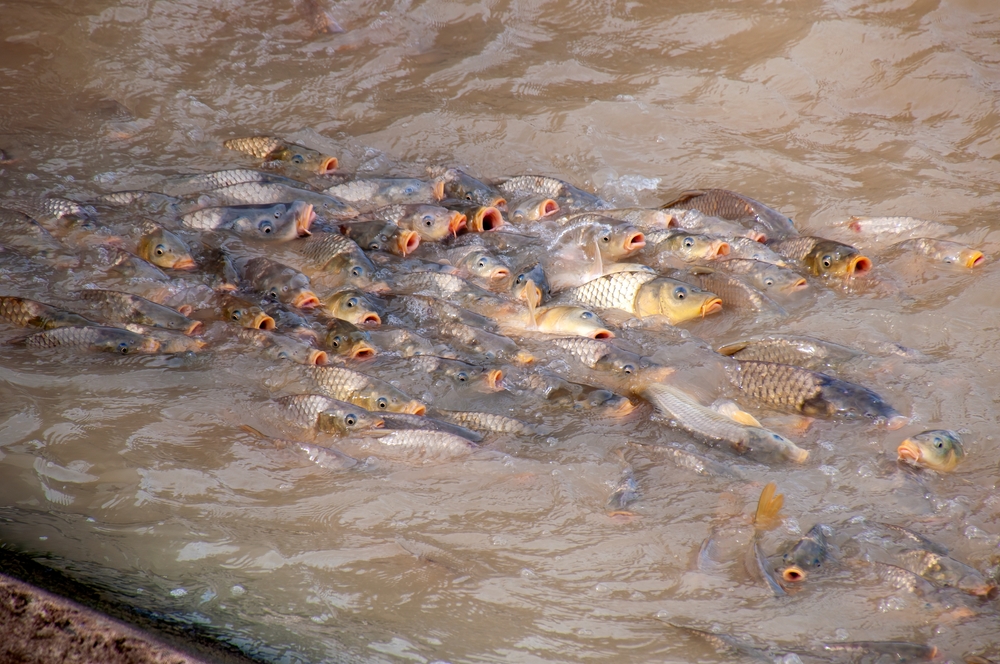
Common or European carp (Cyprinus carpio) is an invasive freshwater species that has been established across Australia’s inland waters for several decades. Their large mouths and feeding style contribute to their environmental damage.
Carp populations can increase quickly with numbers fluctuating in response to breeding conditions associated with seasonal rainfall.
In some river systems, carp can make up as much as 90% of total fish biomass, outcompeting native fish. Their high abundance increases water turbidity, damages aquatic plants, and degrades freshwater ecosystems.
Carp are now in every Australian state and territory except the Northern Territory. Tasmania does not have an established carp population and has largely eradicated the only known infestation.
A virus that kills carp
Day-to-day carp management is the responsibility of state and territory governments. Management programs include carp removal, native fish restocking, installing barriers, electrofishing, and trapping.
These methods are currently not enough to reduce carp numbers and additional approaches are needed.
A virus affecting carp, Cyprinid herpesvirus 3, is present in overseas carp populations and causes a fatal disease.
The Australian Government is considering whether this virus could be used to assist with managing carp populations. This type of solution is known as "biological control" or "biocontrol". Before we can use the virus in Australia, we must be sure that it will not harm native fish or Australia’s ecosystems.
Previous carp virus research
Australia has a world-class biosecurity system. Before any organism can be used for biological control, it must be thoroughly tested and assessed for potential risks. Only then can a decision be made about whether it is safe to use.
A program of carp virus research called the National Carp Control Plan (NCCP) was completed in 2022. The NCCP final report is a huge volume of high-quality research and analysis.
The NCCP was led by the Fisheries Research and Development Corporation. It included specialised virus research, consultation and investigations.
The NCCP report suggests the carp virus could reduce Australian carp populations by up to 60%. It also identified questions about possible environmental impacts and recommended further research. Commonwealth regulators must also complete risk assessments and grant certain approvals before any decision can be made about whether the virus can be used safely and effectively.
Current carp virus research
In 2023, Australian Agriculture Ministers agreed to do more research into controlling carp. This work is part of the Carp Biological Control Program and builds on the National Carp Control Plan.
The current program includes seven Priority Research Actions (PRAs) that will improve knowledge and understanding of the carp virus for use as a biological control agent and will support regulatory assessments:
- PRA 1 – Non-target species testing: Further testing of four additional fish species to confirm the carp virus only affects carp and does not pose a risk to native or non-target species.
- PRA 2 – Environmental impacts: Assessing potential impacts on vulnerable species, aquatic communities and river systems, including ecosystem-level effects.
- PRA 3 - Virus transmissibility: Investigating ecological factors that influence virus transmissibility in carp.
- PRA 4 - Virus effectiveness: Investigating ecological factors that influence virus effectiveness in carp in river systems.
- PRA 5 - Cost-benefit analysis: Undertake a cost-benefit analysis to determine the feasibility of using the carp virus in Australia.
- PRA 6 - Epidemiological modelling: Verifying and refining epidemiological modelling to better predict how the virus may spread and perform in Australian waterways.
- PRA 7 - Integrated carp management methods: Assess complementary carp management options to support safe and effective virus release.
The research will be delivered in two batches. Batch 1 is already underway. For the latest updates on the research, please visit the Carp Biological Control Program Updates webpage.
The research will be guided by the Carp Scientific Advisory Group, a committee of Australian and international subject matter experts. The committee meets regularly to guide research requirements and to interpret research results.
Regulatory assessment and ministerial decision-making
The virus cannot be released without legally required assessments and approvals from Commonwealth regulators. Regulatory assessments consider the risks, benefits, safety, and effectiveness of releasing the virus. These assessments make sure that the virus is safe to use and will deliver valued benefit.
Commonwealth regulators will assess the virus in compliance with the following legislation:
- Agricultural and Veterinary Chemicals Code Act 1994
- Biological Control Act 1984
- Biosecurity Act 2015
- Environment Protection and Biodiversity Conservation Act 1999
The final decision on whether to release the carp virus will be made by all Australian Agriculture Ministers, taking into account research, regulatory assessments, and the national interest. In addition, there may be additional state and territory legislation that must be complied with.
Carp Biological Control Program management and funding
The Carp Biological Control Program will manage the research program and submissions to regulators. The program is being overseen by the Office of the Chief Environmental Biosecurity Officer.
The Carp Scientific Advisory Group, the Environment and Invasives Committee and the Carp Virus Implementation Planning Advisory Group will provide technical, policy, and management advice to support the program.
In 2016, the Commonwealth allocated $15.2 million to investigate the feasibility of using the carp virus in Australia. This funding supported the National Carp Control Plan (2016-2022) and the Carp Biological Control Program (2023 onwards).
Field trials
Field trials using the carp virus have been proposed in the past but they are not required for regulatory assessment or approval. Any field trial would also need separate approvals and would involve significant time and cost to ensure it can be conducted safely and securely. Nevertheless, field trials are supported as a potential first stage before any broadscale release, subject to all required approvals.
Stakeholder engagement
The Carp Biological Control Program continues to engage with stakeholders across Australia, providing regular updates and opportunities to give feedback. This information will be shared through a range of stakeholder networks.
To register for updates, please contact the Carp Biological Control Program at carp@aff.gov.au.
Find out more
- Get Carp Biological Control Program Updates.
- Read The National Carp Control Plan.
- Watch the 2025 webinar Update on the Carp Biological Control Program
- Watch the 2024 webinar The next phase for carp biocontrol.
Contact
Email: carp@aff.gov.au