

PLANT PEST
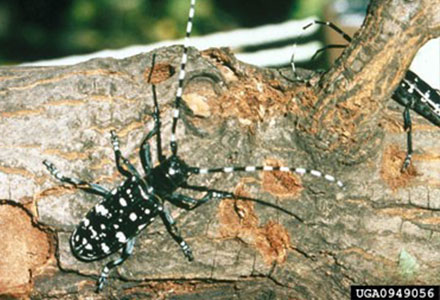
Asian longhorn beetle is up to 3.5 cm long, black with white
spots, and attacks hardwood trees.
Kenneth R. Law, USDA APHIS PPQ, Bugwood.org
Longhorn beetles (exotic species)
Exotic to Australia
Features: Three species of wood-boring longhorn beetles that
attack many kinds of trees
Where they're from: Asia, Europe, North America
How they spread: Importation of infested plants, timber, or
wood packing and dunnage used to secure cargo
At risk: Many trees including apple, pear, citrus, walnut,
stonefruit; many ornamental hardwood trees, freshly cut
logs/timber with bark, some native trees.
Australian Chief Plant Protection Officer, Dr Gabrielle Vivian-Smith, provides an overview of the risks posed by exotic longhorn beetles.
Exotic longhorn beetles are highly invasive and can quickly kill many different kinds of trees.
The Asian longhorn beetle attacks over 100 species of trees including a variety of fruit trees and ornamental trees.
Two other damaging species of longhorn beetle include the black and white citrus longhorn beetle and the white spotted longhorn beetle.
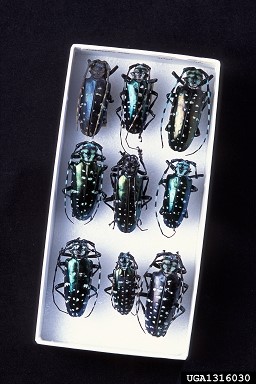
Longhorn beetles are black with white spots and may be identified by their extra-long antennae.
Longhorn beetles may hitchhike to Australia through infested plant material, timber or wood packaging.
If you see a longhorn beetle, take a photo and report it.
Keep it out
Longhorn beetles (Anoplophora spp.) are highly invasive species that can quickly kill trees of many kinds including:
- Asian longhorn beetle (Anoplophora glabripennis)
- citrus longhorn beetle (Anoplophora chinensis)
- white-spotted longhorn beetle (Anoplophora malasiaca).
- attacks over 100 species of woody trees including elm, willow, poplar, maple and a variety of fruit and other ornamental and amenity trees
- larvae feed under the bark and later enter woody tissues
- adults damage trees by feeding on leaves and young bark, with damage to the fruiting shoots of fruit trees resulting in economic loss
- can attack healthy trees as well as trees under stress, quickly overcoming and killing even the healthy trees.
Citrus longhorn beetle:
- attacks the same range of plants as the Asian longhorn beetle, plus citrus, lychee, mulberry, oak, pear, chestnut, fig, walnut, pecan, Rosa, Platanus, Acacia, Casuarina and Psidium and a species of Pinus
- could devastate Australia’s citrus, apple and pear plantations and destroy forests and native bush.
The white-spotted longhorn beetle:
- has a similar host range to Anoplophora chinensis, attacking species in citrus, willow, Acer, blueberry, Alnus and Casuarina.
- could devastate Australia’s citrus plantations and destroy forests and native bush.
Importing goods
To keep longhorn beetles out of Australia, never ignore Australia’s strict biosecurity rules.
Import shipments may need to be treated and certified, so before you import, check our Biosecurity Import Conditions system (BICON).
What to look for
Australia has native species of beetles with long antennae, but look out for these exotic species which are black with white spots, shiny and with extra-long black and white antennae.
Exotic longhorn beetles:
- can grow quite large—Asian longhorn beetle grows up to about 3.5 cm long
- lays eggs under bark
- larvae (grubs) up to 5.6 cm long.
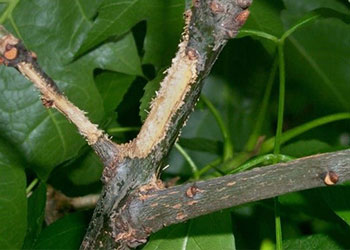
Tell-tale signs of tree infestation include:
- sap oozing from egg laying holes
- stripped bark
- tunnels under the bark and in the wood
- sawdust like frass and wood pulp extruding from oval exit holes 1–2 cm wide
- frass on branches and at the base of an infested tree.
In imported timber, pallets and dunnage:
- tunnels in the wood up to 1.5 cm wide
- sawdust-like frass falling from damaged timber
- oval exit holes about 1–2 cm wide.
Where to look
Importers
Importation of infested plants, wood, wood packaging and dunnage is the most likely way that longhorn beetles would make it to Australia.
In wood, look out for tunnels, oval exit holes up to 2 cm across and frass falling from damaged timber.
Home gardeners
Check hardwood trees including maples, elms, poplars and fruit trees.
Growers
Look out for longhorn beetles and the damage they cause in:
- apple
- pear
- citrus
- apricot
- pecan
- fig.
What to do
If you think you’ve found longhorn beetle:
- take a photo
- do not disturb infested material (this may be as simple as closing the doors on a shipping container or putting a piece of timber into a plastic bag)
- collect a sample.