

PLANT PEST
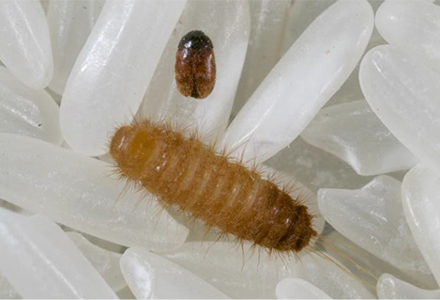
Khapra beetle
Exotic to Australia
Features: A tiny beetle pest that infests stored produce such as grain shipments or silos, eating the produce and making it inedible.
Where it's from: Native to India, but has spread to many parts of the Middle East, Asia, Africa and Europe. A full list of target risk countries can be found on our website.
How it spreads: In infested shipments of imported grain and other foodstuffs, personal effects, machinery, straw, and as a hitchhiker in sea containers and a wide range of cargo (plastic beads, nuts and bolts, timber doors).
At risk: Dried plant or animal products, grains, rice, oilseeds, dried fruits
Australian Chief Plant Protection Officer, Dr Gabrielle Vivian-Smith, provides an overview of the Khapra beetle
Download
If you have difficulty accessing this file, contact us for help.
Keep it out
Overseas, khapra beetle (Trogoderma granarium) is a serious pest of stored grains, rice, oilseeds and dried foodstuffs. In hot conditions, populations build up swiftly, causing significant losses to produce held in stores such as grain in silos. Infested stores also become contaminated with beetles and cast skins and hairs from larvae which can be a health risk.
If the beetle was to establish here, many of our trading partners would reject stored produce from Australia. Given that Australia exports much of the grain we grow, the beetle could cause huge losses, affecting Australia’s economy.
Khapra beetle can survive as a hitchhiker pest in sea containers for a number of years. Due to its small size, its ability to survive for extended periods without food and its preference for inhabiting crevices it can remain undetected under floors and in cracks and crevices in sea containers. When conditions are favourable beetle populations can quickly increase and can contaminate any goods held within the container.
Importing goods
To keep khapra beetle out of Australia, never ignore Australia’s strict biosecurity rules.
Import shipments may need to be treated and certified, so before you import, check our Biosecurity Import Conditions system (BICON).
Urgent actions are being implemented to further strengthen our management of khapra beetle on high-risk plant products that are hosts of this pest, and as a hitchhiking pest in sea containers. These urgent actions impact travellers, online shoppers and stakeholders in the import and shipping industries.
What to look for
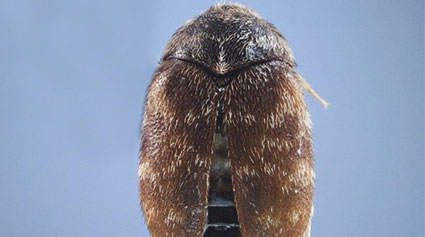
Adult beetles are:
- light yellowish brown to dark brown in colour
- oval shaped
- tiny, just 1.6 to 3 millimetres long.
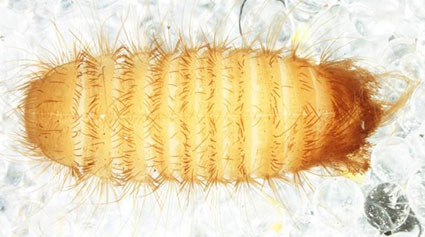
Larvae typically:
- appear very hairy, forming distinctive tufts over the body and giving the appearance of a short tail
- range in size from 1.6 to 4.5 millimetres long
- are initially pale yellow and become golden-brown when they grow.
Where to look
Importers
The most likely way that khapra beetle could make it to Australia is with:
- stored produce including grain, rice, cotton seed, powdered milk and nuts
- containers used for storing or moving produce, including in cracks, under floors and in wall linings of storage/sea containers.
Growers and handlers
- Check stored grain and storage facilities regularly for new pests and unusual damage symptoms.
- Look for cast-off skins.
- It will not be in crops in the field.
- Make sure you are familiar with common storage pests so you can tell if you see something different. The booklet Monitoring stored grain on farm can help with identifying any insects you find.
What to do
If you think you have found khapra beetle:
- do not disturb the insects (this may be as simple as closing the doors on a shipping container or sealing a silo)
- take a photo
- collect a sample, if possible to do so without disturbing the insects.
Human health
While khapra beetle does not pose an immediate risk to human health, when stored products become contaminated by khapra beetles, their cast skins and hairs from its larvae can be a human health risk by causing gastrointestinal, dermatitis and respiratory issues. Larval skins cast by the beetles may cause skin irritation in people handling heavily infested grains. In rare cases, if swallowed, the barbed hairs of the larvae can cause gastrointestinal irritation.
Read the detail
- Urgent actions to protect against khapra beetle
- Khapra beetle pest bulletin
- Plant Health Australia: Khapra beetle fact sheet
- Download the booklet Monitoring stored grain on farm to find out more about this and other pests of stored produce
- Pest Alert! Do you have stowaways on board?