

National action plans improve the way we prepare for, detect and respond to the National Priority Plant Pests (NPPP).
National action plans
See our current action plans for National Priority Plant Pests:
We continue to develop and publish action plans for all NPPPs.
Pests covered under national action plans
This table shows the NPPP included in each current action plan.
| National action plan | National Priority Plant Pest |
|---|---|
| Xylella | Xylella and exotic vectors |
| Khapra beetle | Khapra beetle |
| Hitchhiker pests | Bees (Apis spp.) (exotic species) Invasive snails (exotic species) Mites of bees (Apis spp.) Spongy moth Spotted lanternfly Stink bugs |
| Trees and timber | Bursaphelenchus spp. and exotic sawyer beetle vectors Dutch elm disease Longhorn beetles (Anoplophora spp.) (exotic species) Myrtle (eucalyptus) rust (exotic strains) Pine pitch canker Sudden oak death (airborne Phytophthora spp.) |
| Exotic fruit flies | Fruit flies (exotic) |
| Pests of broadacre crops | Barley stripe rust (exotic strains) Karnal bunt Southern armyworm Stem borers of sugarcane and cereals (Chilo spp.) (exotic species) Texas root rot Ug99 wheat stem rust |
| Pests of horticultural crops | Banana phytoplasma diseases diseases (exotic) Begomovirus and vectors (exotic strains and species) Blood disease and moko disease of bananas ‘Candidatus Liberibacter solanacearum’ complex Citrus canker Fire blight Grapevine leaf rust Grape phylloxera Huanglongbing and vectors Panama disease Phytoplasma 16srl group Plum pox virus (sharka) Potato cyst nematode (exotic strains) Potato late blight (exotic strains) Tobamovirus (exotic strains) |
| Spotted wing drosophila | Spotted wing drosophila |
How the plans work
Each plan:
- outlines the shared responsibility and cooperation between government, industry and research bodies
- establishes how we coordinate business-as-usual and research and development activities.
National action plans contain an implementation schedule. The schedule outlines the actions and project areas. It is also used to record the progress of the actions.
The Plant Health Committee (PHC) oversee the implementation of each plan.
How we develop and manage plans
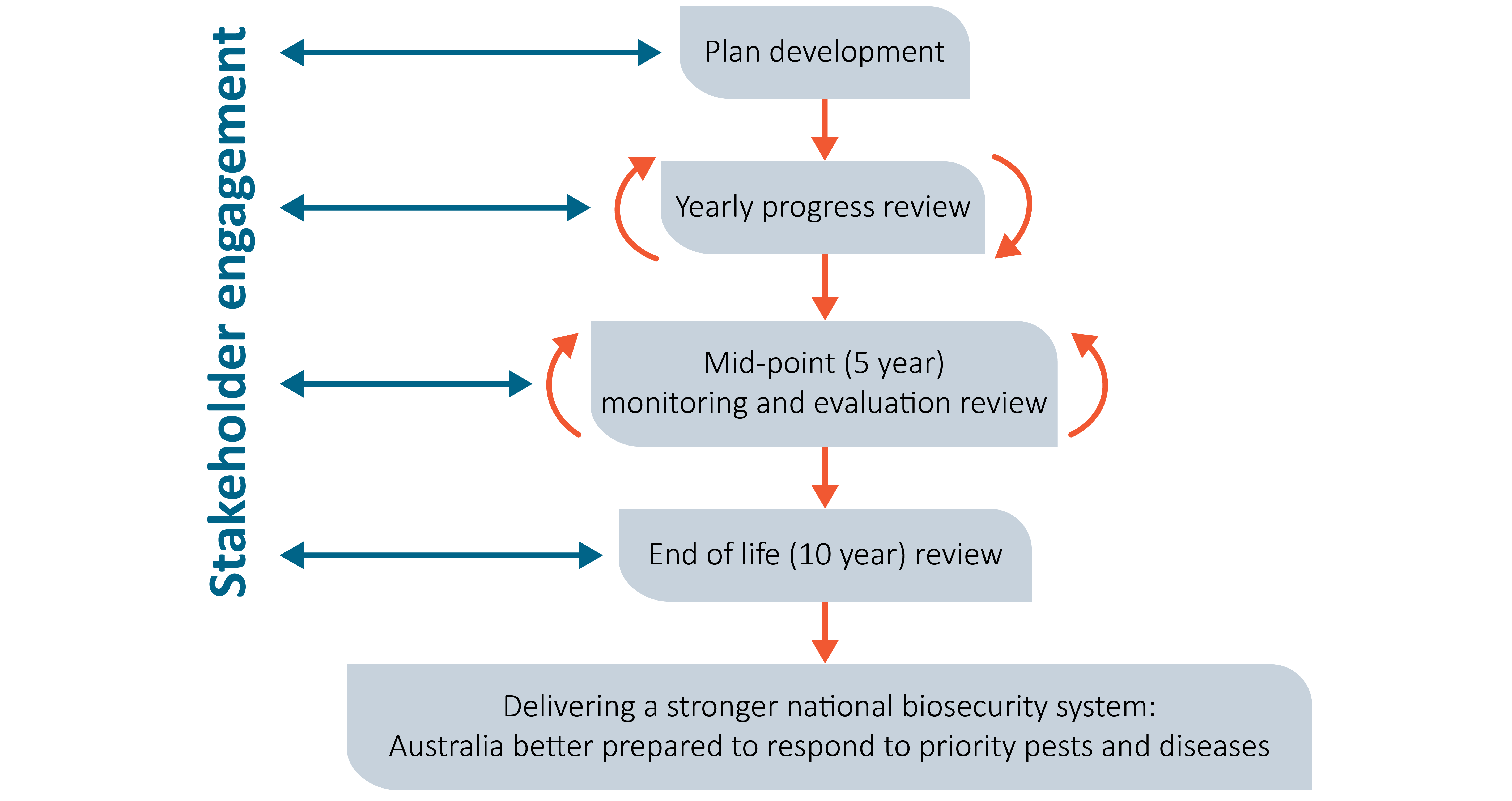
We work with our stakeholders to develop and manage national action plans. They include the Plant Health Committee and the Environment and Invasives Committee.
Endorsement and reviews
Plant Health Committee endorse each plan.
Each national action plan has a 10-year lifespan. They are reviewed annually and at each 5-year mark.
National action plans under development
We are working on these plans:
- National Action Plan for Exotic Fruit Flies
- National Action Plan for Pests of Broadacre Crops
- National Action Plan for Pests of Horticultural Crops
- National Action Plan for Spotted Wing Drosophila
Get involved
Are you a researcher, industry member or someone interested in NPPP preparedness? Email us at plantpestpreparedness@aff.gov.au
Subscribe
Keep up to date with biosecurity news.