

This guide has been developed to assist horticultural produce and cut flower industry participants subject to biosecurity inspections carried out at Approved Arrangements.
Approved Arrangements that follow this guide will improve the efficiency and effectiveness of biosecurity inspections carried out at their premises. Efficient and effective inspections benefit all industry participants by removing unnecessary inspection complexity and delay. This also contributes to faster clearance of goods and lower fees and charges.
The guide supports Approved Arrangements to comply with class 2.4 operating conditions for fresh produce and cut flowers.
The guide
Before the inspection
- Ensure staff are ready to assist the biosecurity officer immediately on their arrival.
- Consolidate the total consignment to ensure safe access for the biosecurity inspection. Do not stack or position items in a way that obstructs visual inspection or handling.
- Have the supporting documents ready. These include the phytosanitary certificate, treatment certificate (if required) and supporting commercial documentation. See more on import requirements (including documentation) on BICON.
- Inspection room must be clean and ready for inspection of imported goods.
During the inspection
- Have staff on hand to provide assistance to support the biosecurity inspection. This includes moving and opening cartons selected by the officer for inspection.
After the inspection
- Repack boxes and cartons and clean the inspection room. This will help prepare for the next inspection.
Are Approved Arrangements required to use the guide?
The better practice guide reflects what ‘good practice’ looks like. Using it is encouraged to ensure you are meeting class 2.4 conditions.
This document does not replace the existing regulatory requirements for Approved Arrangements. Industry participants must comply with the class 2.4 conditions and any biosecurity directions given.
Following the guide will support the department and industry to work together to reduce the potential for clearance delays.
It supports consistent, high-quality implementation of the class 2.4 conditions.
Resources
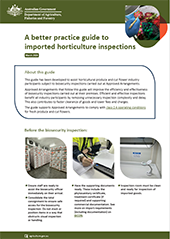
Better practice guide – with images
You can download the guide in A4 and A3. They are designed with images and can be printed or viewed on your device.
If you have difficulty accessing these files, contact us for help.
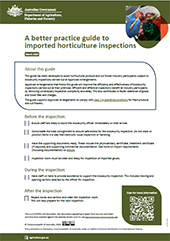
Better practice guide – checklist
Download the checklist version of the guide to help with inspections.
If you have difficulty accessing these files, contact us for help.
Better practice guide - PDF of PowerPoint
Use the PDF PowerPoint version of the guide to educate staff.
If you have difficulty accessing these files, contact us for help.
Your feedback
We welcome feedback or suggestions. This will help us improve the efficiency and effectiveness of biosecurity activities.
Contact us at improvingregulatoryservicedelivery@aff.gov.au.