

Vessels entering Australian territory must comply with requirements under the Biosecurity Act 2015 (ACT).
Australian legislative requirements
Under the Act, aircraft and vessels (including those from Australia) become subject to biosecurity control when entering 12 nautical miles of the Australian mainland or Australia’s external territories.
All international vessels that are sailed, motored or towed through the 12NM limit and enter Australian territory are subject to pre-arrival reporting, pratique, assessment and inspection at a first point of entry on arrival.
Australian External Territories Not Considered Australian Territory (AETNCAT)
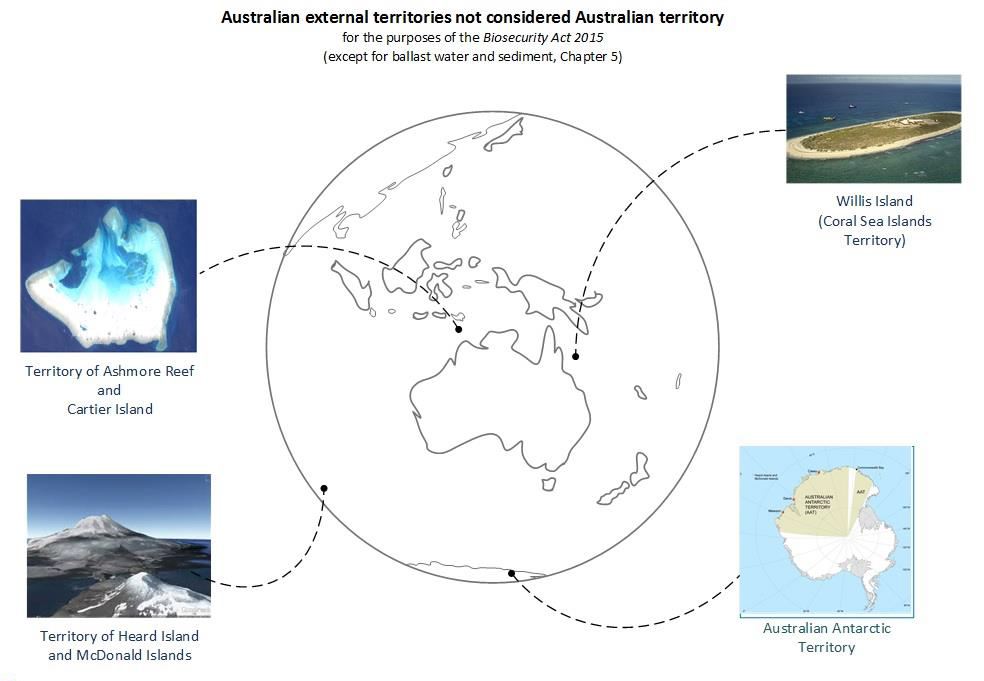
For the purposes of the Act (except for ballast water and sediment, Chapter 5) the Australian external territories not considered Australian Territory are collectively referred to as Australian External Territories AETNCAT. These territories include:
- Ashmore Reef and Cartier Island.
- Coral Sea Islands (Willis Island).
- Heard Island and McDonald Islands.
- the Australian Antarctic territory.
All goods and conveyances from these AETNCAT territories are subject to biosecurity control under the Act unless specified elsewhere.
AETNCAT Locations
The following image indicates the locations of the AETNCAT relative to the Australian mainland.
Biosecurity and the movement of goods and conveyances
From AETNCAT territories to Australian Territory
The Act applies to people, goods and conveyances travelling from AETNCAT territories to Australian Territory in a similar manner to the way the Act applies to the arrival of international goods and conveyances into Australian territory. Each part of regulated Australian territory (for the purposes of the Act) has different import conditions for goods. See more in BICON.
To AETNCAT territories
There are no regulations or restrictions under the Act relating to the movement of goods and conveyances or for the regulation of human health from Australian territory or any other countries to AETNCAT territories.
| AETNCAT | Goods | Conveyances (vessels and aircraft) | Transiting vessels (cruise vessels) |
|---|---|---|---|
| Australian Antarctic Territory | Refer to BICON for movement conditions | All international vessels must submit pre-arrival reporting using MARS. Australian Border Force (ABF) requires all cargo from the Australian Antarctic Territory to be reported via the Integrated Cargo System (ICS) Refer to BICON for movements into Australia | |
| Territory of Heard Island and McDonald Islands | Refer to BICON for movement conditions | All international vessels must submit pre-arrival reporting using MARS. Australian Border Force (ABF) requires all cargo from the Australian Antarctic Territory to be reported via the Integrated Cargo System (ICS) Refer to BICON for movements into Australia | |
| Coral Sea Islands Territory (including Willis Island) | Refer to BICON for movement conditions. Exclusions exist where the vessel returning from Ashmore Reef and Cartier islands is a Maritime Border Command (MBC) or ABF vessel | All international vessels must submit pre-arrival reporting using MARS. ABF requires all cargo from Willis Island to be reported via the ICS | Exempt |
| Ashmore Reef and Cartier Island Territory | Pre-arrival reporting is not required where the vessel returning from Ashmore Reef and Cartier islands is a Maritime Border Command (MBC) or ABF vessel | Exempt | |
| Norfolk Island | Refer to BICON for movement conditions | Granting pratique is not required for vessels arriving into Norfolk Island that have travelled from Australian territory, and vice versa, per Biosecurity (Human Health) Regulation 2016 (Human Health Regulation) Ch6. |
Commercial, including cruise and military, vessel pre-arrival reporting
Vessel masters and shipping agents representing commercial vessels, including cruise vessels, travelling between Australian mainland and the external territories and, between the external territories are required to lodge pre-arrival reporting via the Maritime and Aircraft Reporting System (MARS).
In accordance with section 193 of the Act, commercial vessel operators intending to enter the external territories and/or move between external territories and mainland Australia must report to the department between 96 and 12 hours before the estimated time of arrival of the vessel. Failure to give a report containing the information required may contravene subsection 193(4) of the Act.
For commercial voyages originating outside of Australian Territory, including movements between Christmas Island, Cocos (Keeling) Islands and/or Norfolk Island and mainland Australian, vessel operators must report using the Maritime and Aircraft Reporting System (MARS). Further support materials about MARS is available by contacting conveyance.maritime@aff.gov.au.
Vessel masters and shipping agents representing commercial vessels, including cruise vessels travelling between Australian mainland, the external territories, and between the different external territories are required to lodge pre-arrival reporting via the Maritime and Aircraft Reporting System (MARS).
The following examples outlines reporting requirements for pre-arrival reporting between offshore territories for commercial vessels including cruise vessels:
| Voyage Number | Ports of Call | Pre-arrival reporting |
|---|---|---|
| 1A | Brisbane to Norfolk Island | Yes (Exempt from Pratique) |
| 1B | Norfolk Island to Fremantle | Yes (Exempt from Pratique) |
| 2A | Fremantle to Cocos (Keeling) Islands | Yes |
| 2B | Cocos (Keeling) Islands to Christmas Island | Yes |
| 2C | Christmas Island to Fremantle | Yes |
For information on meeting pre-arrival reporting requirements, visit the Vessel webpage and, for information on using the Maritime and Aircraft Reporting System (MARS) visit the MARS communications and training materials webpage for quick reference and user guides.
For commercial vessel voyages originating from an AETNCAT to Australian territory, including mainland Australia, Christmas Island, Cocos (Keeling) Islands and Norfolk Island, vessel operators must pre-arrival report via the MARS.
Commercial vessels travelling between Australian territory, Norfolk Island and the Indian Ocean Territories are required to lodge a Pre-Arrival Report (PAR) into MARS using a different (unique) voyage number.
The AETNCAT ports are available in the dropdown list of Last port of Call in MARS and in the PAR offline form. When submitting a pre-arrival report into MARS, commercial vessel operators must select an AETNCAT port as the last port prior to arriving in Australian waters. The table below displays how AETNCAT ports are formatted in the Last Port of Call drop down list.
AETNCAT
| Last Port/s of Call – available in the PAR
|
|---|---|
Australian Antarctic territory
| Casey (Antarctica)
|
Ashmore Reef and Cartier Island
| Ashmore Reef and Cartier Island |
Coral Sea Islands (Willis Island)
| Coral Sea Islands (Willis Island) (Australia)
|
Heard Island and McDonald Islands
| Heard Island (Heard Island and McDonald Islands)
|
For information on meeting pre-arrival reporting requirements, visit the Vessels webpage and, for information on using the Maritime and Aircraft Reporting System (MARS) visit the MARS communications and training materials webpage for quick reference and user guides.
Non-commercial vessel pre-arrival reporting
Non-commercial vessel owners, vessel operators and returning Australians are required to report in writing (electronically) via the online non-commercial vessel Pre-Arrival Report (PAR) web portal
In accordance with section 193 of the Act, non-commercial vessel operators intending to enter the external territories and/or move between external territories and mainland Australia must report to the department no earlier than 90 days and no later than 12 hours before estimated arrival time (to the Australian external territory and /or the Australian mainland). Failure to give a report containing the information required may contravene subsection 193(4) of the Act.
For non-commercial vessel voyages originating outside of Australian Territory, including movements between Christmas Island, Cocos (Keeling) Islands and/or Norfolk Island and mainland Australian, vessel operators must report in writing (electronically) via the online non-commercial vessel Pre-Arrival Report (PAR) web portal.
Non-commercial vessel operators are required to submit separate and additional pre-arrival reports for each voyage;
- Originating from mainland Australia to an Australian external territory e.g. between mainland Australia and the territories of Christmas Island, Cocos (Keeling) Islands, and Norfolk Island.
- Originating from an Australian external territory to mainland Australia e.g. between Christmas Island, Cocos (Keeling) Islands, or Norfolk Island and mainland Australia.
- Originating from an Australian external territory to another Australian external territory e.g. Between the territories of Christmas Island, Cocos (Keeling) Islands, and Norfolk Island.
- Originating from an Australian External Territory Not Considered Australian Territory (AETNCAT) to an Australian external territory, or to the Australian mainland.
For information about how to meet pre-arrival reporting requirements, visit the Non-commercial vessel arrival biosecurity reporting – yachts and private superyachts webpage.
For non-commercial vessel voyages originating from AETNCAT territory to Australian territory: including mainland Australia, Christmas Island, Cocos (Keeling) Islands and/or Norfolk Island, vessel operators must report in writing (electronically) via the online non-commercial vessel Pre-Arrival Report (PAR) web portal.
Non-commercial vessel operators are required to submit separate and additional pre-arrival reports for each voyage to Australian territory which originates from;
- Ashmore Reef and Cartier Island
- Coral Sea Islands (Willis Island)
- Heard Island and the McDonald Islands
- The Australian Antarctic territory.
The Australian external territories not considered Australian territory (AETNCAT) ports are available in the dropdown list of Last ports in the non-commercial vessel PAR.
For information about how to meet pre-arrival reporting requirements, visit the Non-commercial vessel arrival biosecurity reporting – yachts and private superyachts webpage
Commonwealth Government legal provisions
The relevant provisions of an Act for government of these external territories as an Australian Territory are:
| Location | Provisions of an Act for government of a territory |
|---|---|
| Australian Antarctic Territory | s 8 of the Australian Antarctic Territory Act 1954 |
| Territory of Heard Island and McDonald Islands | s 7 of the Heard Island and McDonald Islands Act 1953 |
| Coral Sea Islands (including Willis Island) | s 6(1) of the Coral Sea Islands Act 1969 |
| Ashmore Reef and Cartier Island Territory | s 8 of the Ashmore and Cartier Island Acceptance Act 1933 |
Check territory administrator requirements on the Department of Infrastructure, Transport, Regional Development and Communications Australian territories webpage.