
Land uses have a major effect on Australia's natural resources through their impacts on water, soil, nutrients, plants and animals. There is also a strong link between changing patterns of land use and economic and social conditions, particularly in regional Australia. Mapping Australia’s land use underpins agricultural statistics, informs policy development, supports efficient and sustainable primary industries, and enhances efficient operation of Australia’s biosecurity system.
What is land use?
Land use information shows how our land resources are used. This includes the production of goods (such as crops, timber and manufactures) and services (such as defence, recreation, biodiversity and natural resources protection).
Land use reflects both (i) the activities undertaken and (ii) the institutional arrangements put in place for a given area, for the purposes of economic production or the maintenance and restoration of environmental functions (ABS National Land Account, Experimental Estimates). See the definitions page for the distinctions between the terms land use, land cover and land management practice.
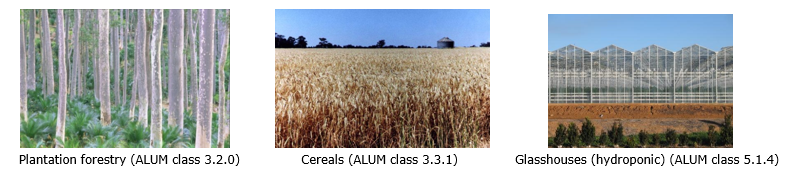
Australia's Land Use
Land use mapping in Australia is conducted broadly at two scales: national scale and catchment scale.
National Scale mapping is suitable for national statistics and change analysis between 2010-11, 2015-16 and 2020-21. The map and area statistics below show national scale land use mapping for Australia for 2020–21.
Catchment scale mapping is a mosaic of the most recent state and territory mapping which was not done at the same time or scale. This is useful for local or regional detail but not suitable for national statistics or change. Catchment scale mapping can be viewed on the ACLUMP website and on the Digital Atlas of Australia.
Both national scale and catchment scale land use datasets can be accessed via the data download page. Detailed information about how Australia's land use is mapped is available on the Mapping technical specifications page.
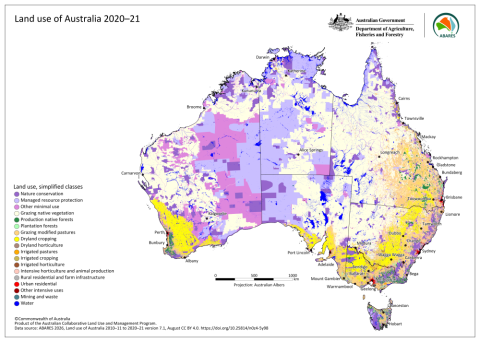
National scale land use (based on Land Use of Australia 2010–11 to 2020–21 v7.1 ABARES 2026)
| Land use in 2020–21 | Area (sq. km) | Percent (%) |
|---|---|---|
| Nature conservation | 722,747 | 9.4 |
| Managed resource protection | 1,433,146 | 18.6 |
| Other minimal use | 914,804 | 11.9 |
| Grazing native vegetation | 3,114,975 | 40.5 |
| Production native forests | 87,390 | 1.1 |
| Plantation forests (commercial and other) | 20,101 | 0.3 |
| Grazing modified pastures | 639,587 | 8.3 |
| Dryland cropping | 410,601 | 5.3 |
| Dryland horticulture | 739 | 0.02 |
| Irrigated pastures | 5,571 | 0.1 |
| Irrigated cropping | 14,461 | 0.2 |
| Irrigated horticulture | 7,518 | 0.1 |
| Intensive horticulture and animal production | 1,394 | 0.02 |
| Rural residential and farm infrastructure | 22,485 | 0.3 |
| Urban residential | 15,573 | 0.2 |
| Other intensive uses | 10,927 | 0.14 |
| Mining and waste | 6,979 | 0.09 |
| Water | 267,142 | 3.5 |
| Total | 7,696,138 | 100 |
Numbers may not tally due to rounding.