
Skip to main content Skip to main navigation Skip to search
forestsaustralia

Help us improve our website

We want to hear from you!

Please share with us your experience using the Forests Australia website to access forest-related data and information. You can help us better understand your needs, what works now, and what could be improved.

Take our quick survey

end link

ABARES - Forests Australia

Top navigation abares

  • Department
  • Ministers
  • Media Centre
Main menu

Main navigation Forests Australia

  • Home
    Home
  • Australia’s forests
    Australia’s forests
  • State of the forests reports
    State of the forests reports
  • Product statistics
    Product statistics
  • Plantation statistics
    Plantation statistics
  • Data and maps
    Data and maps
Department of Agriculture

Breadcrumb

  1. DAFF Home
  2. ABARES
  3. Forests Australia
  4. Australia's forests and forestry glossary
  5. Australia’s forests and forestry glossary

Secondary Forests Australia

  • Forests Australia
    • Australia's forests
      • Forest profiles
        • Australia's forests-overview
        • Acacia forest
        • Callitris forest
        • Casuarina forest
        • Eucalypt forest
        • Mangrove forest
        • Melaleuca forest
        • Rainforest
        • Commercial plantations
    • Forest facts
    • Australia's State of the Forests Report
      • Synthesis 2023
      • Criterion 1: Conservation of biological diversity
        • 1.1a.i Forest area by type
          • 1.1a.i Supporting information
        • 1.1a.ii Forest area by tenure
          • 1.1a.ii Supporting information
        • 1.1a.iii Forest area in RFA regions
          • 1.1a.iii Supporting information
        • 1.1a.iv Forest area change over time
          • 1.1a.iv Supporting information
        • 1.1b: Area of forest by growth stage
        • 1.1c: Area of forest protected for conservation
          • 1.1c: supporting information
        • 1.1d: Fragmentation of forest cover
          • 1.1d: supporting information
        • 1.2a: Forest dwelling species
          • 1.2a: supporting information
        • 1.2b: Threatened forest dwelling species
          • 1.2b: supporting information
        • 1.2c: Representative species monitored
        • 1.3a: Species at risk from loss of genetic variation
          • 1.3a: supporting information
        • 1.3b: Genetic resource conservation
          • 1.3b: supporting information
      • Criterion 2: Productive capacity of forest ecosystems
        • 2.1a: Native forest available for wood production and the area harvested
        • 2.1b: Age class and growing stock of plantations
        • 2.1c: Annual removal of wood products compared to sustainable volumes
          • 2.1c.i Sustainable yield and harvest levels (2024)
          • 2.1c.ii Removals by log type (2024)
          • 2.1c.iii Forecast national log availability (2024)
        • 2.1d: Annual removal of non-wood products compared to sustainable volumes
        • 2.1e: Harvested area regenerated or re-established
      • Criterion 3: Ecosystem health and vitality
        • 3.1a: Forest health and vitality
          • 3.1a Supporting information
        • 3.1b: Area of forest burnt
          • 3.1b: supporting Information
      • Criterion 4: Soil and water resources
        • 4.1a: Area of forest managed for protective functions
        • 4.1b: Management of the risk of soil erosion
        • 4.1c: Management of the risks to soil physical properties
        • 4.1d: Management of the risks to water quantity
        • 4.1e: Management of the risks to water quality
      • Criterion 5: Forest contribution to global carbon cycles
        • 5.1a: Carbon in forests and forest products
      • Criterion 6: Socioeconomic benefits to meet the needs of societies
        • 6.1a: Value and volume of wood and wood products
          • 6.1a: supporting information
        • 6.1b: Values, quantities and use of non-wood forest products
        • 6.1c: Value of forest based services
        • 6.1d: Production, consumption, import/export of wood and non-wood products
        • 6.1e: Degree of recycling of forest products
        • 6.2a: Investment and expenditure in forest management
        • 6.2b: Investment in research and development
          • 6.2b: supporting information
        • 6.3a: Area available for public recreation/tourism
        • 6.3b: Recreation/tourism activities available
        • 6.4a: Area of forest managed to protect the special values of Indigenous people
        • 6.4b: Registered places of non-Indigenous cultural value protected
        • 6.4c: Indigenous values protected through participation in forest management
        • 6.4d: The importance of forests to people
        • 6.5a: Direct and indirect employment
          • 6.5a: supporting information
        • 6.5b: Wage rates and injury rates
          • 6.5b: supporting information
        • 6.5c: Resilience of forest dependent communities
          • 6.5c: supporting information
        • 6.5d: Resilience of forest dependent Indigenous communities
          • 6.5d: supporting information
      • Criterion 7: Legal, institutional and economic framework for conservation and sustainable management
        • 7.1a: Legal framework
          • 7.1a: supporting information
        • 7.1b: Institutional framework
          • 7.1b: supporting information
        • 7.1c: Economic framework
        • 7.1d: Capacity to measure and monitor changes
        • 7.1e: Capacity to conduct and apply research and development
          • 7.1e supporting information
      • About Australia’s State of the Forests Report
      • Past reporting
        • Australia's State of the Forests Report 2018
          • Executive summary
            • Data
          • Criterion 1 Conservation of biological diversity
          • Criterion 2: Maintenance of productive capacity of forest ecosystems
          • Criterion 3: Maintenance of ecosystem health and vitality
          • Criterion 4: Conservation and maintenance of soil and water resources
          • Criterion 5: Maintenance of forest contribution to global carbon cycles
          • Criterion 6: Maintenance and enhancement of long-term multiple socioeconomic benefits to meet the needs of societies
          • Criterion 7: Legal, institutional and economic framework for forest conservation and sustainable management
          • Maps and other graphics
          • Data
        • Australia's State of the Forests Report 2013
        • Australia's State of the Forests Report 2008
        • Australia's State of the Forests Report 2003
        • Australia's State of the Forests Report 1998
      • Mandates and drivers for Australia's State of the Forests Report
      • Benefits of producing Australia's State of the Forests Reports
    • Criteria and Indicators for reporting
      • Alignment of Australia's indicators with Montreal Process indicators
      • Review
    • National Forest Inventory
      • National Forest Inventory Steering Committee
    • Forests, land and Australia’s Indigenous peoples
    • Forest and wood products statistics
    • Plantation inventory and statistics
    • Data, maps and tools
      • Data by topic
        • Area of forest
        • Fire in forests
        • Forest species and ecological communities
        • Indigenous land and forest
        • Native forests
        • Plantation forests
        • Regional Forest Agreements
        • Regional forestry profiles
        • Regional Forestry Hubs boundaries
        • Tenure of forests
        • Wood products statistics
      • Spatial data
        • Forests of Australia
        • Tenure of Australia's forests
        • Australia's Indigenous land and forest estate
        • Fires in Australia's forests
        • Regional Forestry Hubs boundaries
        • Australia's plantations
      • Data visualisations
        • Forestry regional profiles - data visualisation
        • Australia's native forest types - data visualisation
      • Maps
      • Tools
    • Publications
    • Forest agencies and organisations
    • Australia's forests and forestry glossary

Australia’s forests and forestry glossary

Old-growth forest

Ecologically mature forest where the effects of past disturbances are now negligible.

See Ecologically mature, Mature, Senescent.

Open forest

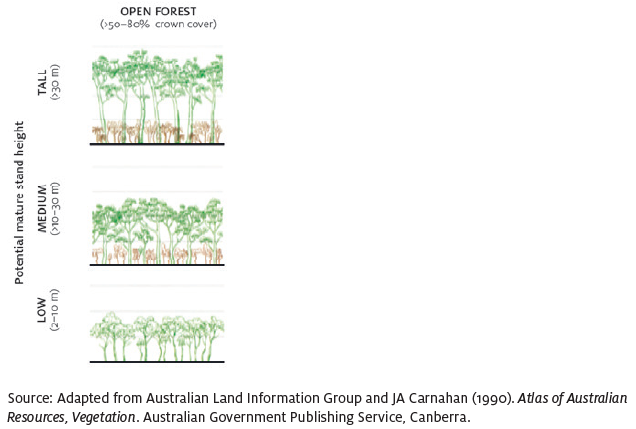
As a National Forest Inventory cover class, forest in which the tree crowns cover from over 50% to 80% of the land area.

See Closed forest, Crown cover, National Forest Inventory, Woodland forest.
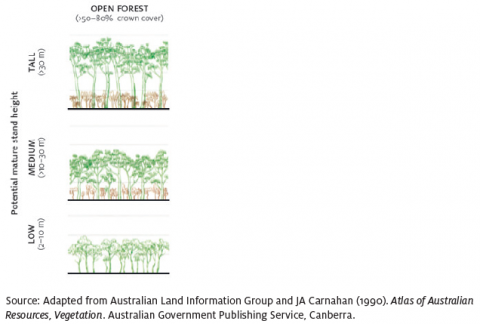
Open forest

Click here for an enlarged version.  

Other Crown land

Crown land reserved for a variety of purposes, including utilities, scientific research, education, stock routes, mining, water-supply catchments, and use by Indigenous communities. Excludes leasehold forest, nature conservation reserve, and multiple-use public forest.

One of six land tenure classes used to classify land in the National Forest Inventory.

See Crown land, Land tenure, National Forest Inventory.

Other forest

A National Forest Inventory forest category that principally comprises non-commercial plantations and planted forests that are not reported through the National Plantation Inventory but that satisfy the definition of forest.

‘Other forest’ includes agroforestry plantations, sandalwood plantations, environmental plantings, plantations within the reserve system, and plantations regarded as not commercially viable. Non-planted forests dominated by introduced species are also included in this category.

‘Other forest’ does not include forest reported in the other two national forest categories, ‘Commercial plantation’ and ‘Native forest’.

See Agroforestry, Commercial plantation, Environmental planting, Forest, Introduced species, National Forest Inventory, Native forest, Plantation, Sandalwood.

Other log products

Low-quality sawlogs, girders, poles, piles, wood used in mines, split and round posts, bush sawn/hewn timber and sleepers, fuelwood logs and firewood, and other logs that are not sawlogs (including sliced veneer sawlogs) or pulplogs. This category can also include other log types if not included elsewhere, such as peeled veneer logs.

Differs from the category ‘Other wood products’ in including fuelwood logs and firewood.

See Other wood products.

Other native forest

As a national native forest type used by the National Forest Inventory, one of several types of forest of minor extent such as those dominated by trees of the genera Agonis, Atalaya, Banksia, Hakea, Grevillea, Heterodendron, Leptospermum, Lophostemon or Syncarpia, as well as native forests where the type is unknown.

See Commercial plantation, National Forest Inventory, Native forest, Native forest type.

Other special rights

A National Forest Inventory category of land or forest subject to Native Title determinations, registered Indigenous Land Use Agreements and legislated special cultural use provisions. Independent of tenure, these can provide Indigenous peoples and communities with the right to access areas of cultural significance, use areas for cultural purposes, or be consulted before major development activities.

See Indigenous co-managed (of land or forest), Indigenous managed (of land or forest), Indigenous owned (of land or forest), National Forest Inventory.

Other wood products

Low-quality sawlogs, girders, poles, piles, wood used in mines, split and round posts, bush sawn/hewn timber and sleepers, and other logs that are not sawlogs (including sliced veneer sawlogs) or pulplogs, but not fuelwood logs or firewood. This category can also include other log types if not included elsewhere, such as peeled veneer logs.

Differs from the category ‘Other log products’ in excluding fuelwood logs and firewood.

See Other log products.

Other woody vegetation

See Sparse woody vegetation.

Outrow

A row of trees felled in a plantation, including to allow travel of machinery.

Over-mature

See Senescent.

Overstorey

1. The uppermost layer of foliage in a forest.

2. Trees occupying the uppermost layer in a forest of more than one layer (storey).

Thanks for your feedback.
Thanks! Your feedback has been submitted.

We aren't able to respond to your individual comments or questions.
To contact us directly phone us or submit an online inquiry

CAPTCHA
This question is for testing whether or not you are a human visitor and to prevent automated spam submissions.

Please verify that you are not a robot.

Skip

We acknowledge the continuous connection of First Nations Traditional Owners and Custodians to the lands, seas and waters of Australia. We recognise their care for and cultivation of Country. We pay respect to Elders past and present, and recognise their knowledge and contribution to the productivity, innovation and sustainability of Australia’s agriculture, fisheries and forestry industries.

Artwork: Protecting our Country, Growing our Future
© Amy Allerton, contemporary Aboriginal Artist of the Gumbaynggirr, Bundjalung and Gamilaroi nations.

Footer

  • Contact us
  • Accessibility
  • Disclaimer
  • Privacy
  • FOI

© Department of Agriculture, Fisheries and Forestry

Facebook X LinkedIn Instagram